
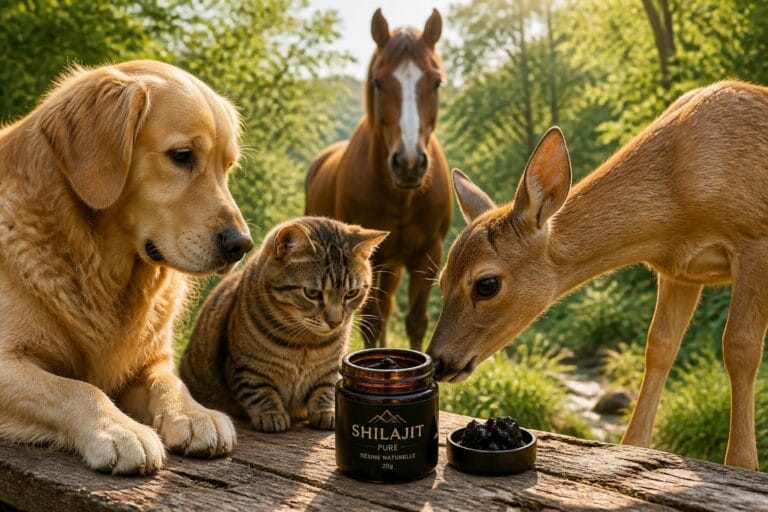
In Brief
Shilajit is a natural resin rich in minerals, humic acids, and bioactive compounds, but its composition varies considerably depending on its origin.
In animals, the most discussed potential effects concern inflammation, oxidative stress, vitality, and joint support.
The scientific basis remains limited: the best clinical data concern 10 arthritic dogs receiving 500 mg twice daily for 120 days.
Testimonials circulating online can be helpful in understanding owners’ expectations but never replace a well-conducted clinical trial.
The main risk relates to quality: heavy metals, mycotoxins, and other contaminants are possible in a poorly purified product.
Before any supplementation, veterinary advice is essential, especially for small animals, fragile subjects, pregnant or nursing animals, or those under treatment.
Shilajit has long fascinated people for its image as a rejuvenating substance from high mountains. In humans, it is often associated with energy, recovery, and overall balance. Whenever a supplement seems promising, a common question arises among attentive owners: can it also help pets, especially as age, arthritis, or decreased tone set in?
The answer requires nuance. Some experimental data support antioxidant, immunomodulatory, and anti-inflammatory properties, and a small study on arthritic dogs has drawn attention. However, the evidence remains too limited to claim a broadly validated solution. Between cautious promises and gray areas, the right approach is to examine product quality, available data, and the individual animal’s condition without improvising dosage.
Natural origin and composition of shilajit: understanding its impact on animals
To assess the interest of Shilajit in animals, one must first understand its nature. It is a dark organo-mineral substance, viscous when warm, harvested in high mountain ranges, notably in the Himalayas and Altai. Its traditional reputation in Ayurveda is based on uses linked to strength, endurance, and regeneration.
You will find a useful basis on what Shilajit really is. This clarification is essential because many products sold online mix marketing folklore with analytical reality. For an animal, this difference is not trivial: a poorly identified product can expose to disproportionate risk.
Millennial formation of shilajit and its key components for animal health
Shilajit forms over very long periods from degraded plant matter then transformed by microbial activity, pressure, and thermal variations. This origin explains its complex composition. It contains humic acids, including fulvic acid, as well as various minerals and bioactive metabolites like dibenzo-α-pyrones.
Fulvic acid is often presented as the functional core of the product. If you wish to go further, the page dedicated to fulvic acid helps understand why it attracts so much nutritional research interest. In animals, questions focus mainly on its possible role in neutralizing oxidative stress, transporting certain nutrients, and supporting digestion, though a systematic clinical effect cannot yet be guaranteed.
Geographical variability of shilajit: influence on its quality and effectiveness
Two batches of Shilajit can display very different profiles. Altitude, rock type, source flora, and purification method influence trace element content, humic acids, and unwanted substances. This is one reason why testimonials can be so contrasting.
For an owner of dogs or other animals, this variability demands real rigor. A product may seem “natural” while being mediocre. Reading this guide to choosing quality Shilajit and these storage tips helps understand why purity, traceability, and stability matter as much as the label. Potential benefit always starts with a clean product.
Biological properties of shilajit and their potential effects on pets
Published work mainly describes plausible biological mechanisms rather than solidly demonstrated veterinary efficacy. This point changes everything: a mechanism observed in the lab is not proof of outcome in pets living in very varied contexts. That said, some signals remain interesting, notably for joint comfort and cellular protection.
Anti-inflammatory and antioxidant effects of shilajit in animals
Experimental studies attribute to Shilajit antioxidant and anti-inflammatory properties linked to its humic fractions and dibenzo-α-pyrones. In several models, a reduction in inflammation markers and better cellular resistance to oxidative stress are observed. For aging or less mobile dogs, this feeds the hypothesis of interesting support, particularly for joints.
A frequently cited review in the literature on the topic mentions the adaptogenic potential of the substance, with interest in cellular energy production and fatigue. Practically, this does not mean a lethargic animal should automatically receive Shilajit. Low tone may also indicate pain, endocrine disease, or heart problems. Clinical common sense must always precede enthusiasm.
Immune modulation by shilajit: experimental data and limits
The immune system is among the most discussed axes. Some data suggest modulation of antibody production and a reduction of inflammatory mediators like histamine or interleukin-6. It is modulation, not blind stimulation, an important nuance in animals sometimes already weakened by age or heavy treatments.
A citation often repeated in scientific summaries sums up the needed caution: “Shilajit has been shown to possess antioxidant, anti-inflammatory and immunomodulatory properties,” but the same literature recalls that clinical applications require more controlled trials. Useful source: NIH, PubMed, https://pubmed.ncbi.nlm.nih.gov/. The take-home message is simple: the mechanism is plausible, common veterinary use is not yet fully so.
Wound healing and cellular protection: observations in animal models applicable to pets
Studies on rats and zebrafish have explored the effects of Shilajit on healing, tissue response, and protection against oxidative stress. The results are interesting as they sometimes show better tissue organization and reduced cellular damage. This may resonate with some owners’ expectations for elderly dogs, post-surgery, or in physiological fatigue phases.
However, a clear line must be kept. Favorable healing observed in an experimental protocol, with strict standardization of diet, environment, and doses, does not directly translate to a pet living at home. A cat with kidney failure, a small poly-medicated dog, or a fragile rabbit do not respond like a lab model. The idea remains promising; veterinary validation is insufficient.
Studies on oxidative stress and implications for animal health
Oxidative stress is involved in aging, certain chronic pains, and decreased cellular function. Shilajit, through its fulvic acid and other compounds, may help limit some of this damage. This is one of the arguments advanced when owners seek overall support for arthritic dogs, those less enduring or convalescing.
| Studied aspect | Available data | Possible interest in animals | Level of caution |
|---|---|---|---|
| Oxidative stress | Experimental models | Theoretical cellular support | High |
| Inflammation | Preclinical studies + small canine study | Possible joint comfort | High |
| Immunomodulation | Mechanistic data | Potential interest in elderly subjects | Very high |
| Wound healing | Controlled animal models | Hypothesis not validated in common practice | Very high |
Limits of extrapolating experimental results to dogs and cats
Dogs and cats have major metabolic differences with lab species. Liver, digestive tolerance, body size, and sensitivity to certain compounds vary markedly. A positive signal in rats therefore does not equate to a clinical green light.
This limit also applies to the pharmaceutical form. Between Shilajit resin or capsules, absorption and ease of administration are not trivial. In animals, choice cannot be copied from human habits. The right question is not “Is it popular?” but “Is it appropriate for this species, weight, and health status?”
Is Shilajit good for animals?
Quickly compare three options for a pet: purified shilajit with certificate of analysis, shilajit without traceability, and classic veterinary joint supplement.
| Option | Purity | Level of scientific evidence | Contamination risk | Ease of dosing | Relevance for arthritic dogs | Recommended caution | Overall score |
|---|
Important
This comparator is informative. For an animal, especially aged, arthritic, fragile, with kidney insufficiency, pregnant, or under treatment, the final decision must be validated by a veterinarian.
To better situate the commonly highlighted human uses, some readers also consult the general benefits of Shilajit, its uses in humans, or its specificities for women. These resources can shed light on the context but should never be used as a shortcut to decide on administration to animals.
Use, dosage, and testimonials on shilajit for animals: current knowledge and recommendations
Owners considering Shilajit often seek help against arthritis, mobility support, or a little boost for vitality. These expectations are understandable. What remains is to distinguish what is a serious lead, a simple testimonial, or too rapid an extrapolation.
Anecdotal experiences and user feedback: why caution is needed
On forums, stories of dogs “livelier,” “more flexible,” or “less stiff in the morning” after a few weeks are regularly read. Such feedback can guide the questions to ask but bears several biases: owner placebo effect, natural symptom variation, concurrent changes in diet or treatment, better adapted physical activity.
A testimonial does not always identify the real quality of the product used.
The given dose is often imprecise or copied from humans.
Negative effects are less often reported than effects perceived as positive.
In other words, field experience should not be dismissed but must be filtered. This is particularly true when seeking an effect on chronic pain or mobility.
Available clinical studies on shilajit in arthritic dogs
The most concrete data concerns a small experiment on 10 arthritic dogs. The protocol mentions administration of 500 mg twice daily for 120 days, with observed pain reduction and no reported side effects in this context. This signal is encouraging, especially because it targets a common situation in aged dogs.
But 10 subjects is a very small sample. Without a large group, significant breed diversity, longer follow-up, and robust comparison with other approaches, it would be unwise to generalize this dosage to all profiles. It gives an order of magnitude, not a universal rule.
Risks related to administration in cats and other animals without scientific data
In cats, data are almost absent. Yet their metabolism is notoriously specific, with particular sensitivity to various substances. In exotic pets (NAC), uncertainty is even higher. For this reason, administering Shilajit without veterinary supervision to other animals than the very limited studied dogs constitutes a poorly calibrated risk.
The reasoning is simple: the smaller, more fragile, or metabolically atypical the animal, the narrower the safety margin. A dosing error, an impure product, or an interaction can have rapid effects. When science is lacking, caution must increase by a notch.
Risks, precautions, and rational choices for shilajit in pets
The heart of the matter is not whether Shilajit is “good” or “bad” per se. It is about determining if a specific product, at a specific dose, for a specific animal, is more likely to help than harm. This logic better protects your companions than general promises.
Dangers linked to contamination and quality variation of shilajit
The main danger comes from the market’s uneven quality. A poorly purified Shilajit can contain heavy metals, microbial residues, mycotoxins, or other contaminants. In small animals, potential impact is increased by low body weight and sometimes limited detoxification capacity.
A reliable product should be purified, analyzed by an independent laboratory, and accompanied by a readable certificate. Provenance, filtration method, and active compound content matter more than appealing marketing speech. To explore the brand universe and its resources, some readers also appreciate the Shilajit Essentials site map, useful for comparing information angles before purchase.
Potential interactions with veterinary treatments and contraindications
Shilajit may theoretically interact with ongoing treatments, notably anti-inflammatories, immunosuppressants, or certain sensitively metabolized drugs. In an already stabilized arthritic dog, modifying therapeutic balance without monitoring can complicate symptom evaluation.
Use should also be avoided in pregnant or nursing females, as well as in subjects with renal or cardiovascular disorders without prior advice. A natural supplement is not automatically harmless. This rule applies even more as formulations genuinely tested for animals remain rare.
Importance of veterinary consultation before supplementation
The veterinarian remains the best filter before any attempt. They can check contraindications, estimate a cautious starting point, monitor clinical parameters, and distinguish simple stiffness from more serious pathology. An old dog slowing down does not always need a supplement; sometimes it needs an assessment.
In practice, many owners appreciate coming with a product sheet, the certificate of analysis, and a list of ongoing treatments. This preparation facilitates concrete exchange and avoids decisions made on a mere reading impression.
Signs to watch to avoid adverse reactions in the animal
If supplementation is validated, observation must be rigorous during the first days and weeks. Reactions to monitor are mainly digestive and behavioral. Decreased appetite, changed stools, vomiting, unusual agitation, or lethargy require stopping the product and quick consultation.
| Observed sign | What it may indicate | Recommended action |
|---|---|---|
| Digestive troubles | Poor initial tolerance | Stop and veterinary advice |
| Loss of appetite | Intolerance or associated pathology | Immediate monitoring |
| Behavioral change | Non-specific reaction | Product suspension |
| Marked fatigue | Interaction or worsening of underlying problem | Consult without delay |
Essential criteria to choose a purified shilajit adapted to animal needs
If the veterinarian considers the trial relevant, prioritize a purified, traceable, analyzed product from recognized high-altitude zones. Check for heavy metal analyses, consistent texture, absence of superfluous additives, and clear information on active concentration. The goal is not to buy “the strongest,” but “the safest.”
It can also be useful to place certain promises in context. Popular uses like Shilajit for weight loss mainly concern humans and should not be transferred to animals. For them, the priority remains safety, therapeutic consistency, and attentive monitoring. When these three conditions are not met, it’s better to abstain.
Can Shilajit relieve arthritis in dogs?
A small study on 10 arthritic dogs showed pain reduction with 500 mg twice daily for 120 days, without reported side effects in this protocol. This signal is interesting, but remains insufficient to recommend generalized use without veterinary advice.
Why should human dosage not be used for an animal?
Metabolism, weight, digestive sensitivity, and associated treatments differ greatly between humans and animals. Copying a human dose increases the risk of error, especially in small-sized or fragile subjects.
Is Shilajit safe for cats?
Scientific data in cats are almost non-existent. In the absence of specific studies and given their particular metabolism, administration should never be improvised.
What criteria should be checked before buying a product?
Look for a purified Shilajit accompanied by laboratory analyses, with heavy metal control, good provenance traceability, and clear composition information. A poorly documented product should not be given to an animal.

As a wellness consultant with over 10 years of experience, I help individuals and businesses incorporate natural health practices to improve their quality of life on a daily basis.