

In Brief
Shilajit is a complex organic mineral resin, whose composition varies greatly depending on the harvesting area, notably in the Himalayas.
The main documented risk remains contamination by heavy metals such as lead, mercury, and arsenic, especially with raw or poorly purified Shilajit.
Digestive disorders related to Shilajit are common at the beginning: nausea, vomiting, diarrhea, abdominal pain, and sometimes electrolyte imbalances.
Allergic reactions exist, ranging from skin rash to bronchospasm, which require immediate discontinuation at the slightest warning sign.
Drug interactions particularly involve anticoagulants, antihypertensives, antidiabetics, immunosuppressants, and several drugs metabolized by the liver.
Pregnant women, children, people with kidney or liver impairment, hemochromatosis, gout, or hormonal disorders should exercise increased caution, or even avoid the product.
The choice of a traceable, independently laboratory-analyzed, and properly purified Shilajit largely determines usage safety.
Long presented as a treasure from the high mountains, Shilajit fascinates as much as it intrigues. This dark, thick substance, sometimes compared to vegetable tar, has been used for centuries in certain health traditions. Yet behind the image of a natural and ancient product, the reality is more nuanced. Its composition is unstable, its origin is not always verifiable, and its claimed benefits coexist with very real risks, especially when product quality is questionable.
The subject deserves close reading, as many consumers discover Shilajit through promises of vitality, performance, or immune support. However, a natural product is not automatically safe. Analyses have shown cases of contamination, digestive disorders, hypersensitivity reactions, and potentially serious drug interactions. The real issue is not whether Shilajit is “good” or “bad” absolutely, but understanding under what conditions its use can become risky.
Understanding Shilajit: composition and chemical complexity
Shilajit is often described as an organic mineral resin slowly formed by the decomposition of plant and microbial matter trapped between mountain rocks. This simple definition hides great complexity. From batch to batch, color, smell, viscosity, and chemical profile can vary. It is precisely this variability that complicates the evaluation of its safety, its potential benefits, and its real risks.
On the ground, the differences are sometimes striking. An amateur athlete buying a premium batch-tested product will not get the same profile as someone ordering a raw extract from an anonymous marketplace. Before even talking about effectiveness, one must understand what the word Shilajit really covers.
Geographical origin and variability of the organic mineral resin
Shilajit historically comes from mountainous regions of Central and South Asia, particularly the Himalayas, but also other areas like the Altai, the Caucasus, or certain regions of China. This geographical origin is not a marketing detail. It directly influences the trace element profile, initial microbial load, and risk of environmental pollutants.
When the resin seeps between rocks due to heat, it absorbs what the environment transmits. Soils, altitude, water, local vegetation, and surrounding human activities alter its composition. Two products labeled Shilajit might share only a family origin without the same purity or level of safety. This is a key factor explaining why studies remain hard to compare.
Main bioactive components of Shilajit: fulvic acid, minerals, and organic compounds
The most frequently highlighted component is fulvic acid, a soluble organic fraction associated with nutrient complexation. To better understand this point, you can consult this resource on fulvic acid. Shilajit also contains dibenzo-alpha-pyrones, humic acids, fatty acids, traces of amino acids, and various minerals.
This chemical richness partly explains the interest in its possible benefits, but it also raises a safety question. The more heterogeneous a substance is, the more its biological behavior can vary. Some people poorly tolerate fulvic acid at certain doses, while others react to ancillary components or impurities from extraction. The bioactive profile driving interest in Shilajit also demands methodical caution.

Commercial forms of Shilajit and implications for usage safety
Today, Shilajit is found in pure resin form, powder, capsules, and standardized extracts. The resin is often perceived as more authentic, but it is not necessarily safer. It all depends on extraction, filtration, and purification processes. Poorly sourced powder can be more problematic than premium resin, while standardized extracts can offer better consistency.
Here is a useful reference to assess the differences:
| Form | Main Advantage | Common Risk | Watchpoint |
|---|---|---|---|
| Resin | Image of naturalness, adjustable dosage | Variable purity | Require toxicological analyses |
| Powder | Sometimes more affordable price | Adulteration or dilution | Verify batch traceability |
| Capsules | Convenient intake | Sometimes unclear dosage | Control actual concentration |
| Standardized Extract | Better consistency | Excessive processing depending on brands | Examine solvents and certificates |
Before being a traditional product, the Shilajit sold today is also a market. It is here that contaminant risks become particularly worrying.
Heavy metals in Shilajit: An underestimated toxic danger
Published analyses on some traditional remedies and Ayurvedic products have regularly highlighted the presence of heavy metals. Shilajit is no exception to this vigilance, especially when raw, insufficiently purified, or sold outside controlled circuits. This is not trivial, as the toxicity of lead, mercury, and arsenic is well documented.
A frequently cited study is that of Saper et al., published in JAMA in 2004 on Ayurvedic products sold in the United States, showing a significant portion contained potentially dangerous metals. Key quote: “One in five Ayurvedic medicines purchased via the Internet contained detectable lead, mercury, or arsenic.” Source: JAMA. Although not all products involved were Shilajit, this highlights the scale of the problem for extracts of uncertain origin.
Frequent presence of lead, mercury, and arsenic and their neurological and kidney effects
Lead can damage the nervous system, mercury affects neurological functions, and arsenic contributes to multisystem damage. For a consumer, the danger is especially insidious because exposure can be chronic, at low doses, without immediate noticeable symptoms. Taking Shilajit daily for several weeks can thus expose to an initially invisible risk.
The kidneys are among the most vulnerable organs. A person already weakened by mild renal failure or repeated dehydration will tolerate a contaminated product less well. This is also why promises of energetic benefits must always be placed within the framework of quality control. An attractive label product can become problematic if certificates are unreliable.
Hepatic impact of metal contaminants and risks linked to non-purified products
The liver participates in neutralizing and eliminating many exogenous substances. When Shilajit contains metallic or organic impurities, liver load can increase. This risk mostly concerns raw products sold as “authentic” without further details. In practice, the word authentic protects nothing if no independent laboratory has verified the batch.
Publications on liver injuries linked to supplements remind us that caution is warranted with any complex extract. The American DILIN registry has extensively documented the growing role of supplements in some liver injury cases. Useful source: NIH. For Shilajit, caution increases when it is unpurified, as contamination can concern both metals and other unwanted compounds. When quality is not proven, the risk scale changes.
Digestive disorders linked to Shilajit consumption
Digestive disorders are among the most common reasons for stopping Shilajit. Many people expect a rapid tonic effect and instead experience abdominal discomfort. This contrast between expectations and reality explains a significant portion of negative feedback observed on forums and in field follow-ups.
Common symptoms: nausea, vomiting, and diarrhea
Nausea, vomiting, loose stools, abdominal cramps, or burning digestive sensations are regularly reported, especially at the start. These reactions occur more often when Shilajit is taken at too high a dose, on an empty stomach, or when product quality is questionable. This is not always an allergy. In many cases, it is primarily a tolerance issue.
A common case: someone starts with a “generous” dose because they read that Shilajit supports energy before training. The first day goes badly, with stomach upset and paradoxical fatigue. The logic is simple: a concentrated product with a dense chemical profile must be introduced gradually. The body does not appreciate shortcuts.
Role of acidity and irritating components on the intestinal mucosa
Fulvic acid and other organic fractions of Shilajit can contribute to digestive irritation in sensitive people. Some preparations also have notable acidity or residual compounds from purification, capable of damaging an already fragile intestinal mucosa. For subjects with gastritis, irritable bowel syndrome, or reflux, tolerance is often poorer.
This irritation is not necessarily serious but should be taken seriously. A slight discomfort initially can evolve into persistent diarrhea if use continues despite signals. The right reflex remains temporary discontinuation, dose evaluation, and checking actual batch quality. Just because a product claims theoretical benefits does not mean it suits all intestines.
Consequences of electrolyte imbalances in prolonged diarrhea
When diarrhea lasts several days, the problem goes beyond digestive discomfort. Water and electrolyte losses can lead to fatigue, dizziness, cramps, headaches, and reduced physical performance. In athletes or elderly people, dehydration sets in faster than imagined.
People taking Shilajit for fitness or recovery must be especially aware of this paradox. Seeking vitality support and ending with hydro-electrolytic depletion is not uncommon when dosage is poorly managed. Digestive caution is therefore not a detail; it is a basic measure.
Management and prevention of digestive disorders for safer use
Some habits significantly reduce the risk:
Start with a very low dose for several days.
Take Shilajit with a light meal rather than on an empty stomach.
Avoid introducing several new supplements at the same time.
Stop at the first appearance of persistent symptoms.
Drink enough fluids, especially in case of loose stools.
For those interested in popular uses of the product, including for weight control, it is important to keep perspective on fast promises around Shilajit for weight loss. Appetite loss linked to poor digestive tolerance is not a sought effect. Safer use always starts with slow progression and attentive listening to body signals.
Allergic risks and vulnerable populations regarding Shilajit
Like any complex substance, Shilajit can trigger allergic or pseudo-allergic reactions. They are less frequent than digestive disorders but require more responsiveness. The common mistake is to trivialize a rash or chest tightness under the pretext that it is a natural product.
Skin and respiratory allergic manifestations: recognizing warning signs
Signs to watch for include itching, redness, hives, lip swelling, tight throat sensation, unusual cough, breathlessness, or wheezing. The rule is simple when these symptoms occur: immediate stop and rapid medical advice. If breathing is affected, urgent action is required.
These reactions may be due to Shilajit itself, an impurity, or an excipient. That is why the consumer’s allergy history matters as much as product quality. A highly atopic person or someone already sensitive to other supplements should exercise enhanced vigilance from the first intake.
Formal contraindications for pregnant women, children, and at-risk individuals
Pregnant or nursing women, children, people with renal insufficiency, liver impairment, hemochromatosis, gout, or certain hormonal disorders should not use Shilajit without explicit medical validation. In the absence of robust long-term clinical data, the precautionary principle prevails. The supposed benefits do not justify risk-taking in these profiles.
Hemochromatosis deserves particular mention, as some Shilajit extracts may contain iron or influence the metabolism of minerals. People prone to gout also require special attention depending on metabolic context. When the condition is fragile, the “natural” argument has no protective value. This is where medical evaluation truly matters.
Dangerous drug interactions with Shilajit
Drug interactions are among the most underestimated risks with Shilajit. Many consumers add it to their routine as a simple wellness support without informing their doctor or pharmacist. However, any bioactive substance can alter a therapeutic balance.
Risks of effects with anticoagulants, antihypertensives, and antidiabetics
Shilajit, potentially influencing certain circulatory or metabolic parameters, can theoretically increase the effect of anticoagulants, antihypertensives, or antidiabetics. The concrete risk is imbalance: easier bleeding, excessively low blood pressure, or unstable blood sugar. Even without exhaustive clinical proof on all products, the precautionary principle is medically justified.
In a diabetic patient already treated, the combination of dietary changes, physical activity, and adding Shilajit can obscure symptom interpretation. Fatigue, sweating, or dizziness should never be quickly attributed to mere adaptation. When a baseline treatment exists, any novelty requires clinical evaluation.
Interactions with immunosuppressants and drugs metabolized by the liver
The issue also arises with immunosuppressants and medications processed by hepatic enzymes. Some plant extracts or organic complexes can influence enzymatic activity, slow down, or modify the metabolism of active molecules. Even if specific Shilajit data remain incomplete, caution should be high.
For those attracted by vitality promises on pages discussing Shilajit benefits, this point deserves a real pause. A product may have theoretical interest yet remain unsuitable in a precise therapeutic context. Safety depends not only on the product but on what it encounters in your body.
Importance of medical consultation before use in patients under treatment
The safest reflex is to show the complete Shilajit label to a healthcare professional before any regular intake. Manufacturer name, exact form, dosage, excipients, and analysis certificate must be examinable. This is especially relevant if you already take multiple medications, which mechanically increases the risk of unanticipated interactions.
In practice, a short consultation can prevent weeks of risky trials. The expected benefit of a supplement only makes sense if it integrates safely into your real medical situation. Caution does not prevent autonomy; it makes it smarter.
Quality and traceability: keys to avoiding Shilajit dangers
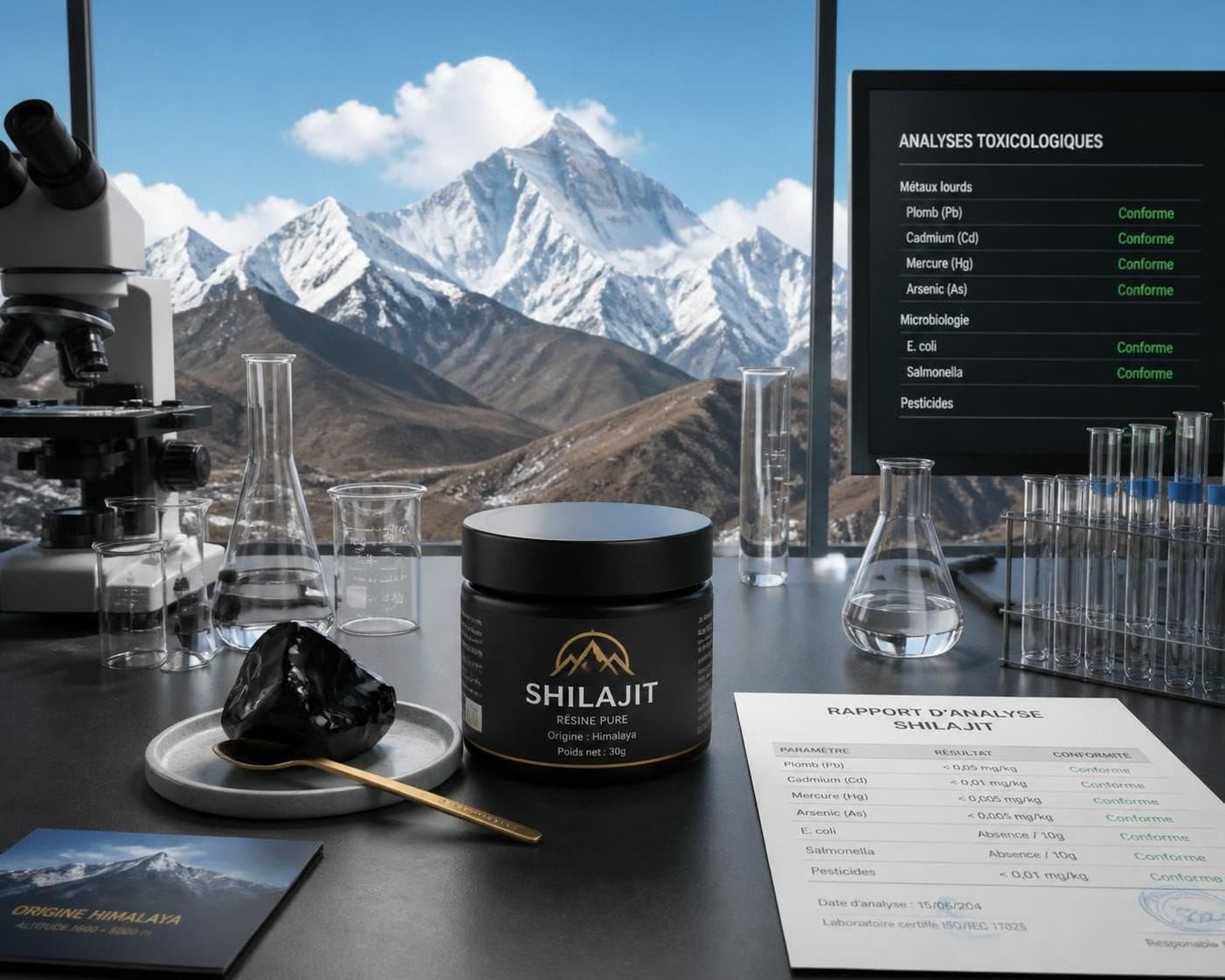
Safety of Shilajit largely depends on quality. A well-extracted, properly purified product, tested for contaminants, and batch traced is nothing like a dark paste sold without proof of origin. This topic goes beyond brand preference. It conditions real exposure to risks.
Selection criteria: extraction, purification, and independent toxicological controls
A good product must specify its origin, extraction process, purification method, and provide independent analyses covering at least metals, microbiology, and overall purity. Ideally, a certificate linked to the batch number, not a generic document impossible to link to your purchase. To go further, this guide on how to choose quality Shilajit helps sort offers more seriously.
The following table summarizes useful signals:
| Criterion | Reassuring Signal | Concerning Signal |
|---|---|---|
| Origin | Specified harvesting area | Vague or missing origin |
| Analyses | Third-party lab, identifiable batch | Unclear or missing certificate |
| Purification | Method explained | No technical information |
| Composition | Fulvic acid content announced with caution | Extravagant figures without source |
| Sale | Transparency and customer support | Anonymous marketplace, exaggerated promises |
Facing a substance as complex as Shilajit, transparency is worth more than attractive talk. Verifiable quality remains the first shield against bad surprises.
Risks linked to raw products and counterfeit goods sold illegally
Untreated raw products and counterfeits sold online pose a growing problem. Some contain little to no real Shilajit, others add undeclared substances to artificially boost the perceived effect. A very black paste, strong smell, or sticky texture alone prove nothing.
Several consumers report receiving resin without batch number, no lab test, and with nearly universal cure promises. This is an obvious warning sign. When marketing replaces traceability, the risk rises, and not only for effectiveness. It rises foremost for health.
Essential precautions for safe Shilajit use
The precautionary logic is not to demonize Shilajit, but to frame its use seriously. Scientific knowledge remains incomplete, and many claims rely on tradition or preliminary, often small studies. This zone of uncertainty justifies a rigorous method rather than spontaneous enthusiasm.
Progressive dosing, avoid taking on empty stomach, and respecting recommended durations
Gradual initiation is the most useful rule. A micro-dose for a few days allows evaluation of real tolerance before any increase. Taking on an empty stomach is often poorly tolerated. It is better to incorporate it into a light meal and avoid too long cycles without breaks.
Phased use with breaks also helps better identify links between Shilajit and possible symptoms. If discomfort appears, the time relation is easier to identify. The body often gives simple signals, but you must leave room for them to express.
Monitoring side effects and role of medical follow-up
Among side effects to watch for: persistent digestive disorders, headaches, palpitations, unusual fatigue, itching, blood pressure variations, or signs of dehydration. Keeping a small journal during the first two weeks may seem trivial but is a very effective way to objectify reactions.
If you have a particular medical background or chronic treatment, medical follow-up adds a precious layer of safety. A blood test or clinical check-up can sometimes be relevant depending on context. With Shilajit, monitoring is not excessive suspicion; it is common sense.
Restrictions and increased vigilance for certain medical conditions
Heightened attention is necessary in case of kidney or liver disease, iron disorders, gout, autoimmune disease under treatment, or endocrine disorders. These situations do not always mean absolute contraindication but require prior medical judgment. The most reliable guideline remains this: the more complex your medical situation, the less room for self-medication. A product may seem simple on the surface and prove much less harmless once faced with an already fragile body.
Summary of documented side effects and user testimonies
Feedback about Shilajit is mixed. Some users mention a subtle feeling of vitality; others mainly describe side effects from the first days. This disparity neither proves universal effectiveness nor product ineffectiveness. It mainly reminds us that tolerance depends on the individual, dose, and actual extract quality.
A common testimony among active people is: “I hoped for more energy but mostly had headaches and an upset stomach.” Such feedback is not rare. It can relate to fulvic acid, excessive dose, impurity, or individual sensitivity. Others’ experiences never replace a careful evaluation of your own situation.
Frequent adverse effects: headaches, fatigue, and digestive disorders
The most commonly described symptoms are headaches, paradoxical fatigue, bloating, nausea, and diarrhea. These side effects often appear during initial intakes or with an overly concentrated product. A cleaner, better dosed, and better tracked dietary supplement form sometimes reduces these issues, but not completely.
When symptoms persist or intensify, the best decision remains to stop and seek professional advice. Blind perseverance brings nothing. With such a variable substance as Shilajit, self-experimentation must always have clear limits.
Rare symptoms: documented metabolic and mineral imbalances
More rarely, metabolic disturbances or imbalances linked to intake of organic compounds and trace elements are mentioned in literature and clinical reports. Data remain limited, urging caution against overinterpretation, but absence of certainty is not a guarantee of safety. This is one of Shilajit’s big blind spots: its long-term effects are still imperfectly known.
The most useful reminder in few words: natural, ancient, and popular do not mean harmless. For Shilajit, the precautionary principle must prevail, especially for at-risk individuals, with prolonged use, or when product origin remains unclear.
Is Shilajit dangerous for everyone?
No, but the risk is not uniform. Healthy people can sometimes tolerate it well, especially with an analyzed product and a low dose. However, pregnant women, children, people with kidney disease, liver disease, hemochromatosis, gout, or on treatment should exercise extra caution and seek medical advice.
How to recognize potentially risky Shilajit?
Warning signs include unclear origin, absence of independent analysis certificate, exaggerated promises, no batch number, and sales on non-transparent channels. A quality product must document its purification and safety tests, especially for contaminants.
Which symptoms require immediate cessation?
Rapid cessation is required in case of skin rash, swelling, respiratory discomfort, repeated vomiting, persistent diarrhea, severe abdominal pain, significant headaches, or unusual fatigue. If severe respiratory or allergic signs appear, urgent care is necessary.
Can Shilajit be taken with diabetes or hypertension treatment?
Without prior medical approval, this is not recommended. Shilajit can cause therapeutic imbalance with antidiabetics, antihypertensives, and other medications. Discussing with your doctor or pharmacist is the safest approach.
Is the resin form safer than capsules?
Not automatically. Resin may seem more authentic, but its safety mainly depends on purification, toxicological analyses, and traceability. A well-controlled, serious capsule may be safer than a raw resin without quality proof.

As a wellness consultant with over 10 years of experience, I help individuals and businesses incorporate natural health practices to improve their quality of life on a daily basis.