
In Brief
Shilajit does not cause rapid weight loss on its own, but can support metabolism, recovery, and energy.
Its most credible effects concern the reduction of fatigue, mitochondrial support, minerals supply, and adaptation to physical activity.
Available data suggest an indirect role in weight loss, especially with a caloric deficit, proper sleep, and regular training.
Fulvic acid, a key component, promotes nutrient transport and contributes to assimilation quality.
Product quality is decisive: prefer a pure resin or a certified extract, with traceability and contaminant analyses.
The usual dosage ranges between 250 and 500 mg per day, with caution in case of medical treatment, pregnancy, or specific hormonal conditions.
Shilajit intrigues because it lies at the crossroads between ancient tradition and modern sports nutrition. Many associate it with a boost in energy, others with better recovery, and some even attribute a direct effect on weight loss. The reality is more nuanced, and that is precisely what makes the topic interesting. When a natural product mainly acts on the metabolic level, resistance to fatigue, assimilation, and effort quality, it can indirectly transform results, never replacing the basics.
For a 42-year-old person resuming sports after several years of a busy professional rhythm, the expected benefit is generally not rapid weight shedding in a few days. What changes first is often the feeling of available energy, the capacity to maintain regular physical activity, and better stability against stress. It is in this context that Shilajit finds its true place: not as a shortcut but as consistent support for a sustainable weight loss strategy.
Natural origin and composition of Shilajit: a mineral treasure serving well-being
Shilajit is an organo-mineral matter resulting from the slow decomposition of plants and microorganisms in mountainous areas. It is harvested notably in the Himalayas, where it oozes from rocks under the effect of heat. Its raw form resembles a dark, dense, and aromatic resin, whose quality depends on altitude, purification, and concentration of active fractions.
To understand what Shilajit really is, one must see it as a complex natural concentrate rather than a simple plant extract. This resin is not limited to an exotic ingredient: it gathers organic acids, trace elements, and humic derivatives that explain its reputation as a global tonic. This biochemical density already sheds light on its possible interest for body composition.
Shilajit: history and use in Ayurveda and modern sports
In Ayurveda, Shilajit is classified among so-called revitalizing substances. Ancient texts attribute to it the ability to support vigor, resistance, and longevity. This tradition does not equal modern proof but has guided contemporary research toward its effects on vitality, recovery, and metabolism.
In current sports, Shilajit is found among ultra-runners, trail runners, triathletes, or bodybuilders who mainly seek support for cellular energy and recovery. The common point is not the promise of a fat burner but the search for better consistency in effort. When regularity progresses, weight loss sometimes follows more easily.
Fulvic acid and essential minerals: nutritional assets of Shilajit
The most cited marker is fulvic acid, an organic fraction capable of binding and transporting various compounds. It is credited with a role in the availability of certain nutrients and digestive balance. To deepen this mechanism, the resource on fulvic acid helps visualize why Shilajit interests lovers of functional nutrition so much.
The presence of minerals and trace elements strengthens its appeal, especially when the diet is restrictive or repetitive. Without correcting a poorly constructed diet alone, Shilajit can act as a complement to the terrain. This angle is often more realistic than the search for a spectacular effect on the scale.
Exceptional composition and concentration in rare nutrients
The quality of a Shilajit resin is judged by its purification, its profile in humic acids, and its analyses. Some references show more than 50% fulvic and humic acids, with controlled levels of heavy metals. Literature also highlights the natural variability of the product, which requires attentiveness to origin and extraction method.
| Form | Main advantage | Point of caution |
|---|---|---|
| Pure resin | Usually more complete profile, traditional use | Strong taste, very variable quality depending on the brand |
| Standardized extract | Dosage more precise, practicality | Risk of overly processed or poorly sourced product |
A good resin is therefore not just about appearance. Its value relies on analytical transparency, which naturally leads to the next question: how can its active compounds act on energy and weight loss?
Active compounds of Shilajit and their effects on energy metabolism
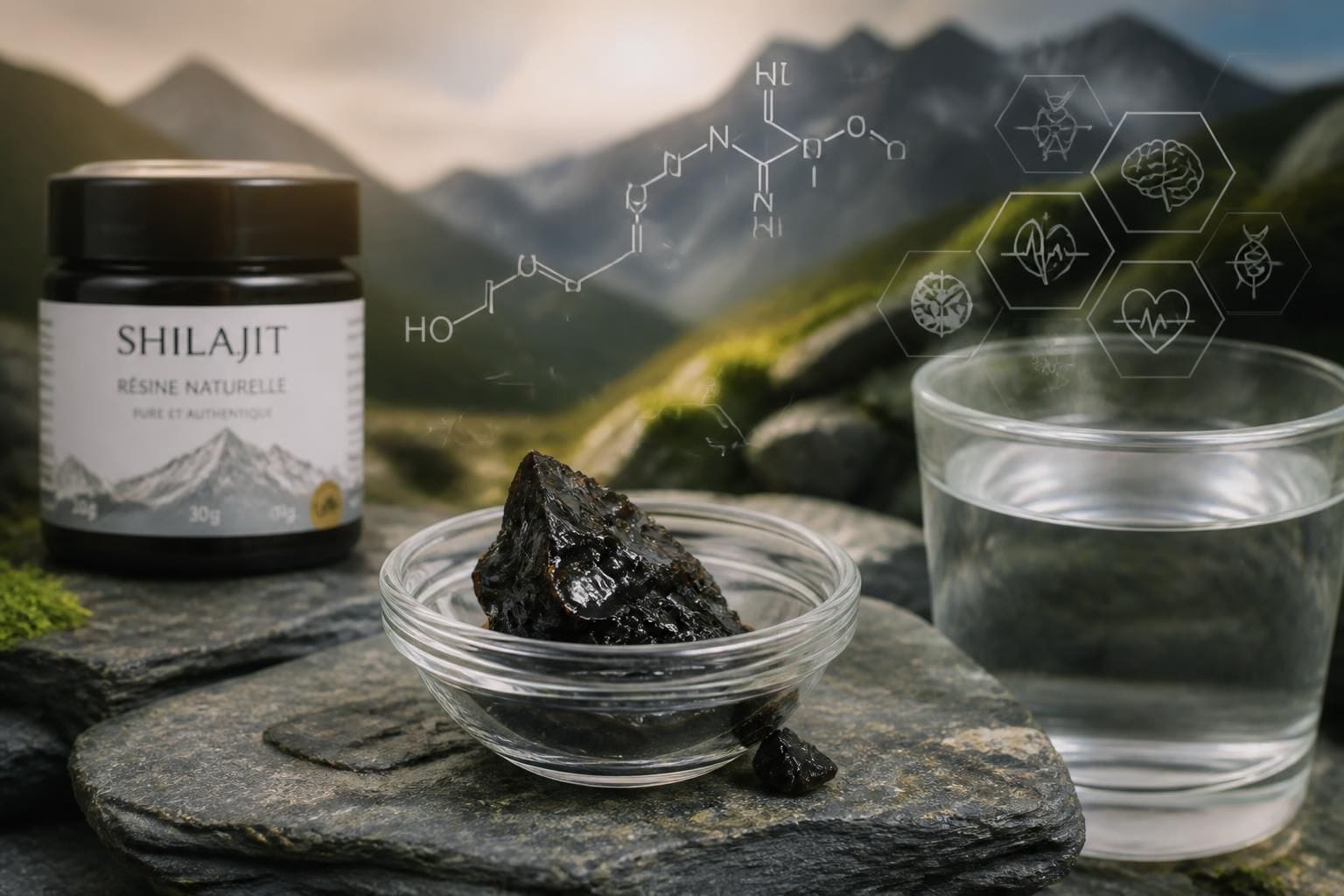
Modern research mainly focuses on the effects of Shilajit on cellular bioenergetics. Several studies suggest a supportive action on mitochondria, those structures that produce ATP, the immediate fuel of the body. This does not mean that Shilajit directly induces weight loss, but that it may improve the efficiency of the system that fuels effort and recovery.
Mitochondrial stimulation and ATP production for better cellular energy
The link between Shilajit and ATP is one of the most often mentioned. A review published in the Journal of Ethnopharmacology highlighted properties related to supporting mitochondrial function and the traditional revitalizing action of the substance. The often-quoted formula is clear: “Shilajit has been used for centuries as a rejuvenator,” which then motivated research into ATP production and recovery.
Practically, when ATP is better supported, some people feel less fatigue at the end of the day or during intense training phases. This improvement remains moderate but can help maintain more stable physical activity. Regularity is one of the first determinants of real weight loss.
Antioxidant and anti-inflammatory effects of Shilajit
Shilajit is also studied for its antioxidant properties. The interest is simple: excess oxidative stress can disrupt recovery, increase perceived fatigue, and hinder performance. In active or returning athletes, this subtle inflammatory terrain sometimes matters more than the number shown on the scale.
Experimental models and some clinical studies suggest a reduction of certain markers linked to inflammation or effort, without justifying therapeutic claims. Shilajit then supports a favorable context for weight loss: better recovery, better sleep, less dropouts. It is less spectacular than a commercial slogan but much more credible.
Improvement of mineral bioavailability: an indirect metabolic support
Thanks to fulvic acid, Shilajit could improve circulation and assimilation of certain nutrients. This point is particularly interesting for people who eat little, train early in the morning, or follow a protein-rich but low-diversity diet. Better minerals status can have a subtle but real effect on daily metabolism.
We then understand why this product mainly acts as a facilitator. It does not “force” weight loss, it helps the body better use what it receives. This is an essential nuance to avoid disappointment.
Does Shilajit cause weight loss?
Quickly compare the expected effects of Shilajit alone, Shilajit with caloric deficit, and Shilajit with caloric deficit plus regular physical activity.
| Context | Effect on energy | Effect on fatigue | Impact on weight loss | Average time to observe | Level of evidence |
|---|
Quick reading
Shilajit alone is mainly perceived as an energy support. The direct effect on slimming remains low without dietary change.
To remember
Caloric deficit remains the main lever for weight loss. Shilajit does not replace a coherent nutritional strategy.
Most favorable context
The combination of caloric deficit + regular physical activity shows the clearest expected impact on weight, with more solid physiological coherence.
Impact of Shilajit on energy expenditure and calorie burning
When looking for weight loss, the central question remains energy expenditure. Shilajit does not act like a classic thermogenic stimulant. It does not abruptly raise body temperature or heart rate as some highly dosed caffeine-based products might.
Moderate activation of basal metabolism without direct thermogenic effect
Support of metabolism by Shilajit seems gradual and indirect. If cellular energy is better available, if fatigue decreases, and if the body manages training better, total calorie expenditure may increase over the week. This is a cumulative logic, not a kick-start effect.
For a person in moderate caloric deficit, this effect can be useful. It helps maintain effort quality without feeling exhausted too quickly, improving program adherence. Weight loss often hinges on this ability to sustain, not on a miracle ingredient.
Shilajit, metabolic facilitator and adaptogens for sports endurance
Shilajit is often placed among adaptogenic supports, even though this category is broad. Its interest lies in helping endurance, recovery, and effort tolerance. For a recreational runner or weekend cyclist, it can make the difference between three sessions followed and quitting after ten days.
A simple example: a person restarting power walking then cycling experiences less baseline fatigue, sleeps better, and manages four weekly workouts. Weight loss then occurs because expenditure increases and the routine becomes sustainable. Shilajit is not the sole engine but can be a good co-pilot.
Influence of Shilajit on hormonal regulation and weight management after 40
After 40, weight management often becomes more sensitive to sleep, stress, recovery, and muscle mass maintenance. Shilajit draws attention because it could act on several of these levers at once, without replacing comprehensive care.
Cortisol modulation and its role in weight control
High chronic stress sometimes promotes cravings, sleep disturbances, and decreased training motivation. If Shilajit helps some people better handle physical and mental load, this can indirectly contribute to weight loss. Cortisol is not the absolute enemy, but its persistent excess often complicates efforts.
On the ground, one mainly observes a benefit in stability: fewer energy slumps, fewer food relapses linked to exhaustion. The best strategy is however still associated with a reasonable caloric deficit and better-protected sleep.
Support of thyroid function and implications on metabolism
The thyroid plays a major role in metabolism. Shilajit is not a thyroid treatment and should never be used as such. However, through its supply of bioactive compounds and minerals, it can contribute to a more favorable nutritional terrain in people without unbalanced pathology.
A person with diagnosed thyroid disorders must imperatively seek medical advice before supplementation. Caution is all the more necessary as some weight variations are hormonal and do not simply depend on will or sport.
Effect on testosterone and muscle mass preservation in men
A few clinical trials, notably in healthy men, reported a moderate increase in total testosterone after Shilajit supplementation. Results do not allow generalization to all, but they are interesting enough to explain its success in some sporting circles.
Better testosterone can help preserve lean mass, thus body composition, especially during a caloric deficit. This does not always translate into faster total weight loss but sometimes a cleaner silhouette. This is often where true visual satisfaction happens.
Shilajit and digestion: detoxification, assimilation, and nutritional support
When diet becomes strict, some feel heavier digestion, lower motivation, or difficulty recovering well. Shilajit then interests for its role in digestive support and assimilation, more than for direct slimming effect.
Role of fulvic acid in toxin elimination and natural chelation
Fulvic acid has binding properties feeding its image as a natural chelator. Without excessive detox discourse, it can help eliminate certain metabolic wastes and improve digestive fluidity. For athletes in load phase or very sedentary people restarting movement, this aspect is sometimes appreciated.
To explore traditional and modern uses, the page dedicated to Shilajit benefits offers a good reference. The useful point to remember remains simple: better assimilation does not automatically mean slimming but creates a more stable terrain for coherent weight loss.
Facilitation of nutrient absorption in strict or high-protein diets
When the diet is very strict, rich in proteins, poor in variety or repetitive, assimilation can become less comfortable. Shilajit, taken as a complement, may help some profiles better tolerate this framework, with less digestive fatigue and a more stable feeling of energy.
It can be relevant for active people who have light lunches but train early.
It can support those who want to preserve muscle mass during weight loss.
It never replaces sufficient intake of fibers, proteins, micronutrients, and hydration.
This nutritional lever remains punctual, useful especially when complementing an already serious base. This often distinguishes smart use from a disappointing purchase.
Summary of scientific evidence on Shilajit’s effects in weight loss
Available science does not show that Shilajit alone leads to marked weight loss. However, several studies converge towards moderate effects on bioenergetics, recovery, resistance to fatigue, and preservation of muscle function. This can positively influence body composition, especially in people who train regularly.
Moderate effects on fatigue, oxidative stress, and metabolism
The most coherent observed effects concern a decrease in perceived fatigue, support for energy metabolism, and some recovery markers. Authors highlight interesting potential but also emphasize the small number of large clinical trials. Methodological caution remains essential.
In other words, Shilajit is neither an empty placebo nor a magic solution. It falls into the category of plausible aids, with benefits mostly visible when the person already moves, sleeps better, and adjusts their diet.
Importance of a complete protocol combining diet, exercise, and recovery
The best scenario remains very concrete: coherent diet, programmed physical activity, serious recovery, then possible addition of Shilajit. In this context, one sometimes sees better effort endurance, more regular training intensity, and gradual improvement in body composition.
The typical case is a person who stalls not because they eat too much, but because they recover poorly and interrupt their program every two weeks. Support of ATP and energy makes all the sense here.
No evidence of rapid weight loss induced by Shilajit alone
No solid data allows affirming rapid weight loss due to Shilajit alone. If a product promises several kilos lost without effort, caution is justified. The most realistic benefits appear after several weeks, with a routine maintained over time.
For those who want to compare serious references or better understand the product universe, this specialized Shilajit resource can serve as a starting point. The right question is not “how much will I lose in 7 days?” but “how to improve my conditions for success?”.
Risks and precautions regarding the quality of marketed Shilajit products
The first limit of Shilajit is not its principle but the quality of what is sold. A poorly purified or controlled resin may contain unwanted contaminants. This is the number one caution point for anyone concerned about health.
Dangers linked to contaminants and heavy metals: importance of traceability
Raw Shilajit can contain heavy metals or other environmental contaminants. That’s why a certificate of analysis, a clear origin, and a documented purification process are required. An authentic but untested resin is not a good choice.
Storage also matters. Poor conservation can alter the texture and stability of the resin. To avoid this, you can consult advice on Shilajit storage, especially about temperature and humidity exposure.
Respect of recommended doses and possible interactions with medications
The usual dosage is between 250 and 500 mg per day. This dosage is generally enough to observe a progressive effect on energy or recovery. Increasing the dose does not necessarily accelerate weight loss and increases the risk of digestive discomfort or interactions.
Caution is advised with antihypertensive, antidiabetic treatment, hormonal disorders, kidney disease, pregnancy, or breastfeeding. If you take medications or have a particular medical condition, professional advice remains the best decision.
| Objective | Realistic expectation with Shilajit | What not to expect |
|---|---|---|
| Weight loss | Indirect support through better routine adherence | Rapid fat mass loss without effort |
| Recovery | Less fatigue, better consistency | Total elimination of soreness |
| Body composition | Possible aid to preserve muscle mass | Automatic physical transformation |
Optimal usage advice for Shilajit to maximize slimming effects
A good product poorly used often gives mediocre results. With Shilajit, practical details matter: chosen form, timing, dilution, and regularity.
Choice between pure resin and certified standardized extracts
Resin is often preferred for its fidelity to the traditional product. It allows a more “raw” approach, appreciated by natural supplement lovers. Standardized extracts make dosage easier and suit those wanting a simple routine.
The decisive criterion remains certification. A serious resin or credible extract must present traceable origin, purity profile, and independent analyses. Between two products, better choose the more transparent than the cheaper.
Ideal consumption mode: dilution, water temperature, and timing
Best practice is to dilute resin in lukewarm water. Too hot water may degrade some compounds, while iced water dissolves the matter less well. Morning on an empty stomach is often the most practical time, and some also appreciate taking it before training.
If your goal is weight loss, morning intake has a double interest: support energy throughout the day and better launch a disciplined routine. The effect is not immediate like a stimulant but can be more stable over time.
Integrating Shilajit into a global strategy for sustainable weight loss
Shilajit makes sense when integrated within a precise framework. True success relies on an overall vision: diet, training, sleep, stress, and consistency.
Association with a hypocaloric diet and sports exercise routine
Sustainable weight loss usually goes through a moderate caloric deficit, often 300 to 500 kcal per day depending on the profile. Shilajit does not replace either nutritional quality or physical activity but may improve tolerance to this framework. This sometimes results in less drop in form and more regularity over several weeks.
Walking more, adding two strengthening sessions, better distributing proteins: this changes the trajectory. Shilajit acts as peripheral support, useful when the basics are already set.
Patience and rigor: observable effects in the long term
First feelings often appear on energy and fatigue, sometimes within two to four weeks. More visible changes in silhouette generally require more time, often six to twelve weeks depending on starting level, sleep, and program quality. This timeline avoids many unrealistic expectations.
Regularity remains key. Weight loss achieved calmly, with better feelings and fewer dropouts, is worth much more than a short, excessive phase followed by rebound.
Differentiating muscle gain and weight gain: truths and misconceptions
Shilajit does not cause fat gain per se. If the weight rises slightly while strength, tone, and visual aspect improve, it may be a favorable evolution of muscle mass. This is frequent among men who resume training and observe better silhouette maintenance.
On the scale, two more kilos can coexist with a smaller waist circumference. That’s why body composition matters more than the raw number. If you use Shilajit wisely, the goal is not only to weigh less but to be more functional, stable, and resilient in daily efforts.
Does Shilajit cause weight loss without dieting?
No. Shilajit does not show solid evidence of direct weight loss without lifestyle changes. Its interest is mostly indirect: better energy, less fatigue, more stable recovery, and easier maintenance of a dietary and sports program.
What dosage to choose to start?
The most often recommended dosage is between 250 and 500 mg per day. Starting low allows checking digestive tolerance. In case of chronic illness, medication, or specific hormonal conditions, it is better to seek medical advice.
Is resin better than capsules?
Resin is often appreciated for its traditional profile and natural richness, but a certified standardized extract may be easier to dose. The main criterion remains analytical quality, traceability, and absence of contaminants.
How long until an effect is seen?
Energy or recovery sensations can appear within a few weeks. For more visible changes in body composition or weight loss, several additional weeks are usually required, provided there is a moderate caloric deficit and regular physical activity.

As a wellness consultant with over 10 years of experience, I help individuals and businesses incorporate natural health practices to improve their quality of life on a daily basis.