
In Brief
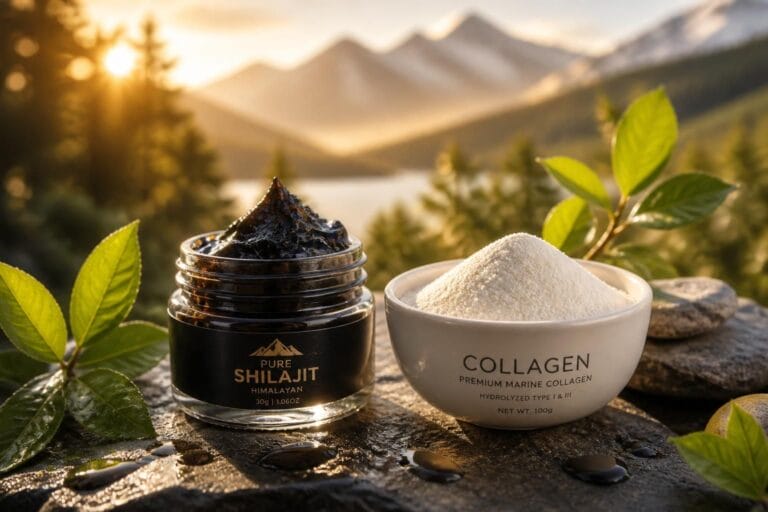
Shilajit provides minerals, fulvic acid and antioxidant compounds useful for cellular vitality.
Hydrolyzed marine collagen targets skin, connective tissues and joints thanks to its good bioavailability.
The Shilajit + collagen duo combines stimulation of cellular functions and supply of structural building blocks.
The expected results mainly concern energy, skin firmness, joint comfort and tissue recovery, with caution and regularity.
Product quality remains decisive: purity, traceability, heavy metal control and appropriate dosage over at least 8 to 12 weeks.
Long reserved for traditional pharmacopoeias of Central Asia, Shilajit now invites itself into modern wellness routines for its unique bioactive profile. Facing it, hydrolyzed marine collagen has established itself as a reference to support skin, supportive tissues and musculoskeletal comfort. The growing interest in their combination is not a fashion trend: one helps optimize the cellular environment, the other provides targeted peptides useful to tissue structure.
This complementarity attracts both active people and those who want to prevent visible signs of aging. When fatigue sets in, recovery slows down, or the skin seems to lose density, it becomes relevant to understand what each substance can really bring, with nuance. The right reflex is to look at the mechanisms, formula quality and usage precautions before any cure.
Origin, composition and benefits of Shilajit for cellular health
Geographical origin and bioactive composition of shilajit
Shilajit is a natural substance derived from the slow decomposition of plant material in mountainous areas, notably the Himalayas, Altai, Caucasus and certain regions of Tibet. Under the effect of pressure, time and climatic variations, this material turns into a very concentrated dark resin. In Ayurvedic texts, Shilajit is associated with resistance and longevity, but current interest mainly rests on its biochemical analysis.
Its richness lies in the presence of minerals, trace elements, dibenzo-alpha-pyrones, polyphenols and especially fulvic acid. This acid plays a key role in solubilizing and transporting nutrients. According to several analyses published in the Journal of Ethnopharmacology, the composition of Shilajit varies depending on altitude, extraction method and purification, which explains the large quality differences observed on the market. Origin is therefore never a detail.
Mechanisms of action: cellular energy, ATP and nutrient transport
The main interest of Shilajit for vitality comes from its potential action on mitochondrial function, where cells produce their ATP, the central molecule of energy. A review by Carrasco-Gallardo et al. published in 2012 highlighted the possible role of dibenzo-alpha-pyrones and fulvic acid in supporting cellular metabolism. Practically, this can translate for some people into a better sense of background energy, more stable than a sudden stimulant.
Shilajit also seems to facilitate the transport of certain nutrients across membranes, which is particularly interesting for fatigued profiles or athletes. An amateur triathlete, for example, rarely looks for an artificial “boost”; they seek cleaner recovery, better effort tolerance and consistent nutritional availability. It is precisely on this logic of cellular optimization that Shilajit is studied.
Immune virtues and natural stimulation of collagen synthesis
Thanks to its antioxidant compounds, Shilajit can help better manage oxidative stress, a factor involved in cellular aging, fatigue and some tissue alterations. Its immune action is not an absolute shield. However, several studies suggest support for homeostasis, notably via modulation of low-grade inflammation. This can have an indirect interest for the skin and connective tissues.
One point attracted attention: researchers from Ohio State University observed, during Shilajit supplementation, increased activity of genes related to the extracellular matrix and muscular collagen. Caution remains essential: the study is interesting, but its interpretation would gain robustness with a better documented control group. The hypothesis remains credible: Shilajit could promote a more favorable environment for internal collagen production.
Available forms, purity criteria and safety of shilajit use
Shilajit is mainly sold as resin, capsules or tablets. The resin remains the form closest to the raw material, but it requires serious manufacturing and precise dosing. Tablets or capsules offer more daily convenience, provided the extract used, actual concentration and safety analyses are verified.
Importance of fulvic acid concentration and heavy metal elimination
A good Shilajit should display a relevant fulvic acid content, often sought above 15% to 20% depending on serious manufacturers. Independent certificates of analysis for lead, mercury, arsenic and cadmium are also necessary. Without these guarantees, it’s better to walk away, as this substance from rocky zones can concentrate contaminants if poorly purified.
Criterion | Reliable Shilajit | Warning Sign |
|---|---|---|
Origin | Location specified, clear traceability | Unclear or missing origin |
Purity | Available third-party analyses | No analytical proof |
Fulvic acid | Content indicated | Percentage not mentioned |
Safety | Heavy metal control | Marketing claim without certificate |
Choosing between resin and tablets: tips for optimal consumption
Shilajit resin appeals to users who want to finely adjust the dose, diluting it in lukewarm water or a non-hot drink. Tablets are better suited for busy schedules and travelers. In both cases, start gradually to assess tolerance, especially if you are sensitive to concentrated supplements.
Hydrolyzed marine collagen: key protein for skin, joints and vitality
Structural role of collagen in connective tissues and impact of aging
Collagen is the most abundant structural protein in the human body. It is found in the skin, tendons, ligaments, cartilage, bones, hair and nails. With age, its production gradually decreases, sometimes as early as the thirties, while tobacco, excess UV, stress and insufficient protein intake accelerate its degradation.
This decrease is visible and felt. The skin loses firmness, wrinkles deepen and some people describe less flexible joints or less pronounced recovery after training. Collagen is therefore not only an aesthetic issue; it also affects movement mechanics and tissue maintenance.
Bioavailability and essential amino acid profile of marine collagen
Hydrolyzed marine collagen comes in shorter peptides, improving digestion and absorption. It notably provides glycine, proline and hydroxyproline, amino acids particularly interesting for connective matrices. A study by Proksch et al., Skin Pharmacology and Physiology, 2014, showed improved skin elasticity after 8 weeks in some women supplemented with collagen peptides. Source: https://karger.com/spp/article/27/3/113/295637
The marine choice also attracts for its fine powder and ease of use. It can be included in yogurt, a drink or a smoothie without major constraint. For many, this simplicity promotes regularity, and it is precisely regularity that conditions real effects.
Collagen supplementation: prevention of skin aging and joint support
Collagen supplementation aims to support dermal matrix density and supportive tissue comfort. In some people, after 2 to 3 months, the skin texture appears smoother, flexibility improves and feeling of tightness decreases. For joints, the goal is not to replace medical follow-up but to accompany lifestyle, especially when physical activity is regular.
For skin beauty, usual doses often range from 2.5 g to 10 g per day depending on the product.
For joint or sports support, protocols often increase to 10 g daily.
Combination with vitamin C, quality proteins and sufficient sleep improves terrain coherence.
Collagen and sports performance: repair and maintenance of muscle tissues
In athletes, collagen is not an immediate performance booster. Its interest lies more in repairing supportive tissues, tolerance to repeated impacts and mechanical recovery. For an intensive runner or swimmer, preserving tendons, fasciae and musculo-tendinous junctions can make a real difference over a whole season.
This logic becomes even more interesting when combined with a favorable metabolic terrain, which naturally leads to synergy with Shilajit. One provides peptides, the other could improve their use in an organism under effort.
Shilajit and collagen: clear and useful comparison
Explore the differences, strengths and possible complementarity between shilajit and collagen to better understand their role in a wellness routine aimed at vitality, skin and youth.
Interactive Comparison Table
| Criterion | Shilajit | Collagen |
|---|
Beneficial synergy between shilajit and collagen: mechanisms and visible effects
Stimulation of endogenous collagen synthesis by minerals and fulvic acid
The complementarity between Shilajit and collagen rests on a simple idea: the first improves the biological terrain, the second provides structural elements. The minerals, fulvic acid and the effect of Shilajit on cellular transport can foster a context more conducive to endogenous collagen synthesis. This logic interests both muscle recovery and skin tissue quality.
A quote aptly summarizes the useful scientific caution here: “The observed gene expression changes warrant further investigation in controlled trials.” This remark from exploratory work around Shilajit reminds us that a biological signal is not a clinical promise. But on the ground, this articulation between cellular stimulation and peptide supply remains coherent.
Concrete effects on skin, wrinkles, firmness and reduction of joint pain
In diligent people, the combination of Shilajit and collagen is sought for visible effects on the skin: clearer complexion, increased firmness sensation, sometimes less marked fine wrinkles and better surface quality. Collagen contributes to structure, while Shilajit can support the oxidative and nutritional environment necessary for renewal.
On the locomotor level, several users report better comfort of joints, especially when the cure accompanies work on hydration, mobility and training load. It would be excessive to see it as a universal solution. The logic of lubrication, cartilage support and discomfort reduction deserves attention.
Anti-inflammatory action of shilajit amplifying the benefits of collagen
Shilajit is also interesting for its moderate anti-inflammatory potential. When low-grade inflammation slows recovery, skin quality and tissue comfort, any reasonable support of the terrain can improve the benefits of a collagen cure. In active people, this dimension is sometimes perceived by a more stable energy sensation and a more linear recovery.
In other words, Shilajit does not act instead of collagen, it can reinforce its physiological coherence. This is an essential nuance to avoid unrealistic expectations.
Biochemical complementarity: gene activation and supply of essential amino acids
The combination of Shilajit and collagen is particularly relevant when the goal mixes appearance, recovery and vitality. Shilajit seems to influence cellular pathways related to the extracellular matrix, while hydrolyzed collagen provides the amino acids necessary to maintain tissues. The logic can be summarized as: signal on one side, material on the other.
Supplement | Main targeted effect | Interest in synergy |
|---|---|---|
Shilajit | Cellular vitality, nutrient transport, adaptive support | Prepares a favorable environment |
Hydrolyzed marine collagen | Support of connective tissues, skin, mechanical comfort | Provides targeted peptides |
Combination | Global approach structure + metabolism | Complementary, non-redundant action |
Practical recommendations for optimal use of shilajit and collagen
Quality, traceability and safety: choose certified and safe supplements
Before any cure, prefer a Shilajit with third-party analyses, documented origin and verifiable purification. For collagen, look for a clearly identified hydrolysate, without excess additives, with transparency on marine origin. A serious brand explains its raw material, dosage and tests, instead of vague promises.
If you are under treatment, pregnant, breastfeeding or have a chronic illness, medical advice is recommended. This simple step avoids unnecessary incompatibilities.
Dosages, galenic forms and recommended cure duration for lasting results
For Shilajit, common uses are often between 250 mg and 500 mg per day depending on concentration. For collagen, the usual window is between 5 g and 10 g per day. A cure of 8 to 12 weeks is a realistic basis to observe durable evolution, especially for skin and tissue recovery.
Practical forms are well known: resin or capsules for Shilajit, hydrolyzed powder for collagen. The best form is not the trendiest, it’s the one you will actually take every day.
Ideal time of consumption and phases of progressive adaptation
Shilajit is willingly taken in the morning or before the first part of the day, especially by those seeking more energy. Collagen can be consumed at any time, provided it is regular. Some prefer to take it after training or at breakfast to anchor the habit.
A simple strategy is to start with half a dose of Shilajit for a few days, then increase if tolerance is good. This gradual increase suits sensitive organisms well.
Comparison of profiles: differences, target audiences and usage precautions
Which specific needs does each supplement address?
Shilajit mainly addresses people seeking support for vitality, cellular energy and adaptation to fatigue. Collagen targets more directly structural needs: skin firmness, connective tissue support, mechanical recovery and joint comfort. Both overlap among active people over 35, endurance athletes and those attentive to visible aging.
Contraindications and advice for sensitive populations
Shilajit requires more caution in cases of gout, iron overload, kidney disease or use of specific treatments depending on clinical context. Marine collagen should be avoided in known fish or seafood allergies depending on the source used. In these situations, it is better to seek personalized advice than to improvise.
The most reliable reflex remains the same: choose a clean Shilajit, a well-dosed collagen, and give the body time to respond. The quality of the daily gesture counts more than a spectacular promise.
Can Shilajit and collagen be taken together?
Yes, their combined use is generally considered to associate cellular vitality support and structural contribution for skin and connective tissues. It is preferable to start gradually and seek medical advice in case of treatment or pathology.
How long does it take to see an effect?
For Shilajit, some people perceive an improvement in energy within days to weeks. For collagen, effects on skin or joint comfort often require 8 to 12 weeks of regular intake.
Which form of Shilajit to choose?
Resin is appreciated for its raw character, while capsules or tablets facilitate intake. The priority criterion is not the form but purity, traceability, fulvic acid concentration and proof of heavy metal elimination.
Is marine collagen superior to other forms?
Hydrolyzed marine collagen is highly valued for its bioavailability and ease of use. It is not universally superior but is a coherent option for skin, supportive tissues and simple daily routines.

As a wellness consultant with over 10 years of experience, I help individuals and businesses incorporate natural health practices to improve their quality of life on a daily basis.