
In Brief
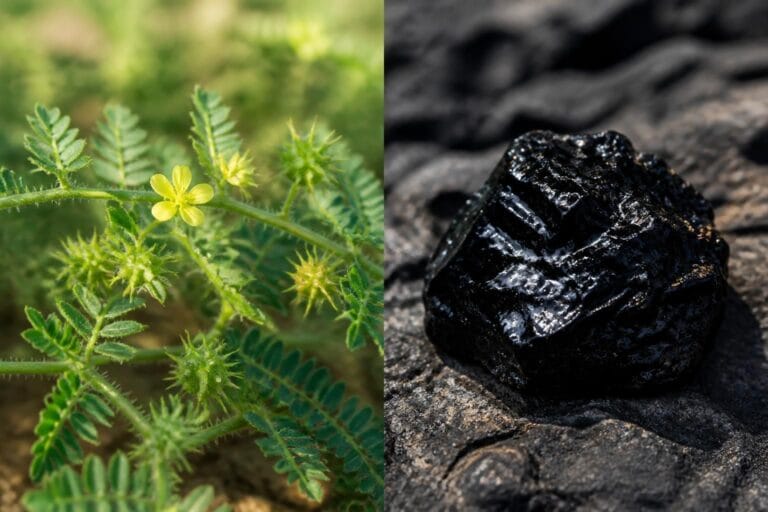
Shilajit and Tribulus terrestris do not belong to the same functional family: one is a complex mineral resin, the other a plant rich in saponins.
The best human data more strongly support Shilajit for energy, recovery, endurance, and certain hormonal markers.
Tribulus terrestris mainly retains traditional and targeted interest on libido, with inconsistent hormonal results in healthy men.
Quality makes all the difference: heavy metal control for Shilajit, agricultural residues and standardization for Tribulus terrestris.
A combination can make sense if the goal combines energy, metabolism, and libido, provided that purity, traceability, and individual tolerance are verified.
Between quick marketing promises and truly useful data, choosing between Shilajit and Tribulus is not as simple as a slogan on a label. These two supplements are regularly mentioned for male vitality, recovery, performance, or libido, but they do not work in the same way, nor with the same level of evidence. The first stands out for its broad metabolic action, linked to fulvic acid, minerals, and mitochondrial support. The second relies on plant compounds, notably saponins, associated with an ancient traditional use for desire and sexual vitality.
To help you sort out the essentials, the key point is to separate popular uses from clinical results. For an active reader, like Marc, 47 years old, who seeks to boost his daily energy without scattering focus, the rational choice will not be the same as for a person whose sole priority is libido. This is precisely where the comparison becomes useful: understand the mechanisms, assess the studies, identify the true quality criteria, then adjust the dose and precautions according to your profile.
Origin and composition of Tribulus versus Shilajit: understanding their fundamental differences
Botanical nature of Tribulus and characteristics of specific saponins
Tribulus is a creeping plant known botanically as Tribulus terrestris. It grows in hot and dry areas, from Asia to the Mediterranean basin, and its fruits as well as aerial parts are used in various traditional medicinal systems. Its interest in supplementation mainly rests on its steroidal saponins, the most cited being protodioscin.
These saponins are plant molecules capable of interacting with complex biological pathways. In commercial arguments, they are regularly associated with testosterone, but human literature calls for more caution. Their role seems more credible on certain aspects of sexual function, particularly libido, than on a clearly reproducible hormonal increase in healthy subjects. The first fundamental difference thus appears here: tribulus is a plant extract with targeted activity, dependent on its extraction standard.
Complex mineral resin of Shilajit rich in fulvic acid and essential minerals
Shilajit is not a plant. It is a natural substance resulting from the slow decomposition of plant organic matter, mixed with a mineral matrix, compressed over centuries in mountainous environments. It is notably harvested in the Himalayan massifs, but also in other high-altitude regions. Its composition makes all its uniqueness: fulvic acid, dibenzo-alpha-pyrones, trace elements, humic acids, and trace minerals.
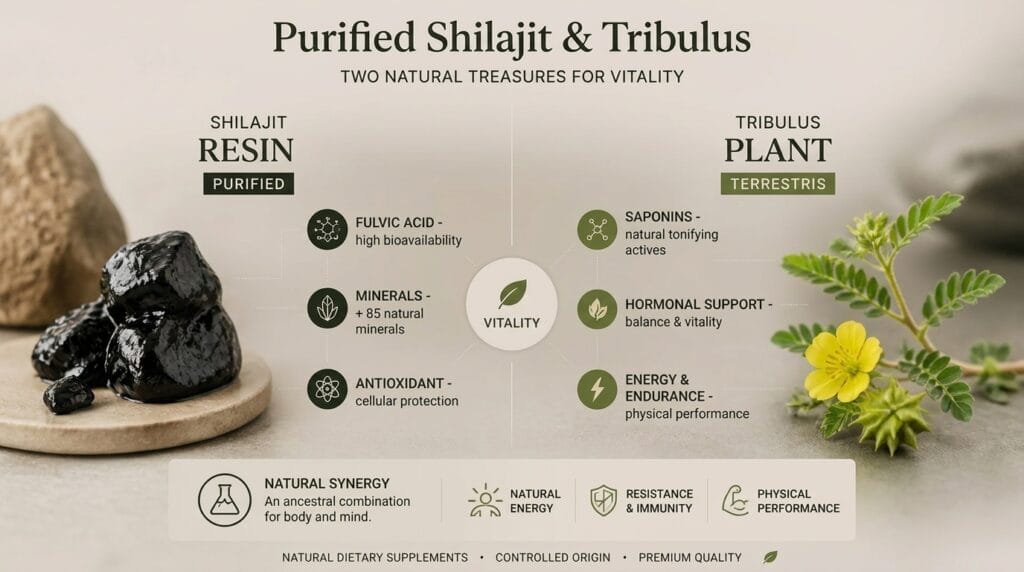
On international labels, you will sometimes see the mention fulvic acid. This fraction is particularly studied for its role in nutrient transport and its bioavailability. A well-purified Shilajit thus behaves like a multifactorial concentrate, with a broader logic than a simple botanical extract. When seeking an action on energy, recovery, and metabolic balance, this difference in nature already changes the product’s reading.
| Criterion | Shilajit | Tribulus |
|---|---|---|
| Origin | Natural organic mineral resin | Medicinal plant |
| Key compounds | Fulvic acid, minerals, dibenzo-alpha-pyrones | Saponins, mainly protodioscin |
| Functional orientation | Energy, metabolism, overall support | Libido, traditional sexual use |
| Watchpoint | Heavy metals if insufficient purification | Variable quality, pesticides, low standardization |
Biological and physiological mechanisms of action of Shilajit and Tribulus
Mitochondrial stimulation and increase in free testosterone by Shilajit
Shilajit draws attention because it acts on several levels. The first concerns mitochondria, those cellular structures involved in energy production. Review studies, including one published in the Journal of Ethnopharmacology, describe Shilajit as an agent able to support mitochondrial function via its dibenzo-alpha-pyrones and fulvic acid. Concretely, this translates to better tolerance to effort for certain users, more stable recovery, and a feeling of energy more consistent than a mere stimulating boost.
The second mechanism concerns the hormonal axis. A 2016 human clinical study, published in Andrologia by Pandit et al., reported that supplementation with purified Shilajit for 90 days in healthy men could increase total testosterone, free testosterone, and DHEAS. The most cited sentence sums up well the interest of the observed signal:
Purified Shilajit supplementation significantly increased total testosterone, free testosterone and dehydroepiandrosterone
Source : https://pubmed.ncbi.nlm.nih.gov/26395129/ .
This is rare, in the world of male supplements, to have a study so often cited on a protocol of this duration.
Traditional effects of Tribulus on libido and hormonal scientific controversies
Tribulus has historically been associated with sexual desire and vigor. This use crosses several traditions, explaining its lasting popularity. In practice, some users describe an improvement in libido and sexual interest after a few weeks, especially when fatigue, stress, or age contributes to decreased tone.
The difficulty arises when seeking a clear hormonal translation. In healthy men, trials have not robustly confirmed a direct rise in testosterone. Some studies show little or no effect on endocrine markers despite a subjective positive feeling on libido. In other words, the potential interest of tribulus must not be confused with a reliable hormonal booster. This is an essential nuance to avoid a purchase based on unrealistic expectations.
Critical analysis of clinical studies on Shilajit and Tribulus terrestris
Proven efficacy of Shilajit on testosterone and physical performance: 90-day study
The scientific dossier of Shilajit remains imperfect, but it is more coherent than that of tribulus. The 90-day study on healthy adult men is the most cited strong point. It used 250 mg twice daily, i.e., 500 mg daily of purified Shilajit. Beyond hormones, other publications explore the impact of this resin on fatigue, recovery, and muscular performance, with interesting signals, especially when training is regular.
For an endurance athlete or an active person alternating intense work and cardio sessions, the interest of Shilajit is less about a spectacular effect than about foundational support. It concerns potential improvement of cellular efficiency, better nutrient utilization, and sometimes better tolerance to training load. This logic of progressive support is more credible than a promise of rapid transformation.
Limits of clinical evidence of Tribulus in healthy men and pathological context
For tribulus, the analysis must be tighter. In healthy men, results on testosterone and performance are generally disappointing or heterogeneous. Differences in extracts, populations, and protodioscin concentrations complicate reading further. It is the typical example of a popular supplement whose reputation exceeds the available evidence.
On the other hand, some works suggest interest in more specific contexts, notably certain sexual function or desire difficulties. A review published in Maturitas noted more favorable data on erectile function and libido in certain profiles, without turning tribulus into a universal solution. The reasonable message is therefore simple: in healthy men mainly aiming for muscle mass or hormonal increase, evidence remains weak; in a more targeted context, the product can keep a place.
Interactive comparator
Tribulus or Shilajit?
Quickly compare the two options according to your goal, level of evidence, expected mechanism, ideal profile, quality controls, and budget.
Quick reading
Generally speaking, Shilajit is better suited for overall energy, while Tribulus is more aimed at targeted libido.
| Plant / substance | Main goal | Level of clinical evidence | Dominant mechanism | Ideal user profile | Quality control to check | Average budget |
|---|
Quick verdict
Shilajit: best choice for overall energy
If your priority is general vitality, recovery, and a more transversal feeling of energy, Shilajit stands out as the most coherent option.
To remember
- • Shilajit: more oriented towards overall energy and general tone.
- • Tribulus: more oriented towards targeted libido depending on context of use.
- • Always check quality, standardization, and manufacturer transparency.
Advantages, disadvantages and essential quality criteria to choose Tribulus or Shilajit
Risks of contaminants and side effects: heavy metals versus pesticides
A poorly purified Shilajit can contain problematic mineral contaminants, notably lead, arsenic, or mercury. This is the hidden side of the raw product. That is why a serious Shilajit must always be accompanied by laboratory analyses, ideally batch by batch. Conversely, for tribulus, the risk is more about pesticides, residual solvents, and irregular botanical quality.
In terms of side effects, Shilajit is generally well tolerated when purified, but it can cause mild digestive disturbances in some sensitive people. Tribulus can also irritate the digestive system or cause discomfort, particularly if the dose is high. The real issue is therefore not just “natural”, but the actual quality of the finished product.
Standardization and essential certifications: fulvic acid for Shilajit, protodioscin for Tribulus
To compare two references, request concrete indicators. On the Shilajit side, standardization in fulvic acid is a useful benchmark, with an explicitly announced percentage, as well as the mention of purification. For tribulus, look for standardization in saponins and, preferably, a specified content of protodioscin. Without this, you are buying a name, not a reliable composition.
A good reflex is also to check GMP, HACCP, or ISO certifications, and third-party analyses. In vitality supplements, purity is not a marketing detail; it is a safety condition. The product that is the “strongest” on paper may be less interesting than a more modest but perfectly controlled extract.
Importance of purity and third-party analysis to guarantee safety and reliability
When a manufacturer publishes certificates of analysis, you finally have tangible elements: heavy metals, microbial load, chemical residues, authenticity of raw material. For Shilajit, this transparency has particular value, as raw resin must never be confused with a ready-to-consume product. For tribulus, third-party analysis mainly helps avoid underdosed or adulterated extracts.
A useful practical tip is to favor brands that detail origin, extraction method, and contaminant thresholds. It is a simple filter but highly effective in weeding out dubious references.
Notable cost differences and implications for the consumer
Good quality Shilajit generally costs more than tribulus. This difference is explained by the relative rarity of the material, purification, and analytical controls. In the short term, this may deter purchase; in the medium term, a better standardized and better documented product avoids repeated expenses on ineffective references.
Tribulus is more accessible, making it an attractive supplement to test an effect on libido. But a very low price should alert you to the actual active concentration. The right purchase is not necessarily the cheapest one, but the one with a coherent quality, safety, and personal goal ratio.
Functional approach: generalist adaptogenic effect of Shilajit versus targeted action of Tribulus
Multifactorial metabolic regulation and global benefits of Shilajit
Shilajit stands out for its generalist profile. It accompanies several dimensions at the same time: cellular energy, effort management, mineral support, recovery, sometimes better mental clarity in tired people, and possible hormonal support in certain contexts. In highly solicited profiles, this multifactorial character makes the difference because real fatigue is rarely linked to a single variable.
In practice, this type of supplement is of interest to people who want to improve their overall routine rather than exclusively target sexual desire. For the amateur athlete as well as the active professional, Shilajit has more the profile of foundational support than a punctual accelerator. It is precisely this systemic vision that explains its reputation as a broad adaptogen.
Specific impact of Tribulus on libido and absence of proven direct testosterone stimulation
Tribulus has a narrower logic. Its main interest remains libido and, in some people, a feeling of sexual tone. Conversely, the idea of a direct, clear, and constant effect on testosterone does not hold well against clinical trials in healthy men. This clarification avoids misunderstandings and reposition the product in its true field of use.
If your priority is general endurance, recovery or daily energy stability, tribulus seems less convincing. If your goal is very targeted, linked to desire, its place can be discussed more calmly, provided you choose a serious extract and accept a sometimes modest effect.
Potential synergies and interests of a Tribulus-Shilajit association in supplementation
Improvement of absorption and energy metabolism by Shilajit
Combining Shilajit and tribulus can make functional sense if expectations are well defined. Shilajit provides a metabolic foundation: better nutrient utilization, support for energy production, more stable recovery, and, in some subjects, better comfort during endurance effort. In a combined formula, it plays the role of a structuring base.
This strategy is mainly discussed for people who feel diffuse fatigue accompanied by decreased desire. Shilajit does not replace coherent lifestyle habits but it can strengthen the foundation on which other actives act. This is where the combination becomes more interesting than a simple addition of marketing claims.
Libido support effect by Tribulus with joint zinc and selenium provision
Tribulus can then intervene as a supplement targeted on libido. In some formulas, the addition of zinc and selenium seeks to support normal hormonal synthesis and antioxidant protection. The idea is not absurd because these micronutrients participate in physiological balance, but their presence does not magically turn the product into a hormonal booster.
When choosing a combination, vigilance on composition becomes even more important. Check the actual amount of Shilajit, zinc form, possible selenium presence, and especially the standardization of the tribulus extract. A poorly dosed complex formula can cost more without clear benefit.
Usage recommendations, dosage and precautions with Tribulus and Shilajit
Dosages validated by clinical studies and adaptation according to user profiles
For Shilajit, the most cited reference remains 250 mg twice daily of purified Shilajit for 90 days, i.e., 500 mg daily. Other formats exist, resin or capsules, but the most useful is to think in terms of purified extract quantity and fulvic acid content. For an active person seeking better recovery, this basis is generally more relevant than a fuzzy dosage.
For tribulus, studies use various ranges, complicating comparisons. Better to choose a product specifying its standardization rather than an isolated “high dosage” promise. In practice, adaptation depends on the goal: global support with Shilajit, focused libido with tribulus, or cautious combination for a mixed approach. Protocol coherence matters more than automatic quantity increases.
Shilajit: favor a purified extract, standardized in fulvic acid, with contaminant analyses.
Tribulus: look for a clear content of saponins and ideally protodioscin.
Start low if you have a sensitive digestive system.
Evaluate the real effect after several weeks rather than after a few intakes.
Medical consultation, risk of interactions and overdose monitoring
A medical consultation is particularly advisable in case of chronic treatment, hormonal, renal, cardiovascular pathology, or fertility disorder. Shilajit can indirectly interact with certain supplementation strategies already rich in minerals; tribulus also requires caution if you take treatments with hormonal or metabolic aims. For people with complex conditions, professional advice remains the safest choice.
Monitoring overdose makes sense, even with natural products. If you notice digestive agitation, headaches, unusual discomfort or feeling the supplement does not suit you, you should reconsider the intake. Proper use is not accumulating capsules, but staying aligned with your actual need, tolerance, and chosen product quality.
| Profile | Most coherent option | Why |
|---|---|---|
| Overall fatigue, decreased energy, slow recovery | Shilajit | Mitochondrial, mineral and broader metabolic support |
| Targeted decrease of libido | Tribulus | More oriented action on sexual desire than testosterone |
| Sport routine, performance and general vitality | Shilajit | More credible basis for recovery and effort |
| Complete approach with fatigue + desire | Cautious combination | Possible complementarity if impeccable quality |
Does Shilajit really increase testosterone?
The strongest human data are more favorable to Shilajit than to tribulus. A 90-day study in healthy men showed an increase in total and free testosterone with purified Shilajit, but this does not replace hormonal assessment or medical follow-up if you have persistent symptoms.
Is tribulus useful if you do sports?
Tribulus may interest some athletes if the goal mainly concerns libido or a feeling of tone. However, for strength gain, testosterone or improved endurance, evidence remains limited in healthy men.
How to recognize a good Shilajit?
Check purification, fulvic acid standardization, third-party analyses, absence of heavy metals beyond regulatory thresholds, and manufacturer transparency. Purity of a Shilajit is the foremost criterion before price.
Can Shilajit and tribulus be taken together every day?
Yes, in some cases, but only if the goal is clear, tolerance good, and composition reliable. A combined formula must remain reasonable, with explicit dosages and medical advice if you have treatment or pathology.

As a wellness consultant with over 10 years of experience, I help individuals and businesses incorporate natural health practices to improve their quality of life on a daily basis.