
In Brief
Shilajit and Maca neither have the same origin nor the same composition, but both aim for vitality and energy.
Shilajit, a mineral resin from the Himalayas, stands out for its fulvic acid, minerals, and support of endurance, memory, and testosterone.
Maca, a root from the Andes, provides complex carbohydrates, a faster tonic effect, and useful action on libido, mood, stress, and fertility.
The choice depends on the main need: lasting energy, mitochondrial and male hormonal support for Shilajit; more nutritional boost, hormonal balance, and sexual tone for Maca.
Quality, traceability, heavy metal control, and medical advice in case of treatment, pregnancy, breastfeeding, or pathology remain essential.
Shilajit or Maca? The question arises among people seeking more energy, better endurance, support for libido, or natural help against fatigue. Behind these two very popular names lie two radically different realities: on one side, a mineral resin born in the high mountains; on the other, a food root cultivated on Andean plateaus swept by cold and altitude. Their comparison therefore deserves more than a simple marketing match.
The most useful thing is to look at their origin, composition, and concrete uses. Scientific studies exist, with varying levels of evidence, and local medical traditions offer valuable insights without exaggerating their effects. A study published in Andrologia in 2016, for example, observed an increase in certain androgenic parameters with purified Shilajit in healthy men, while reviews on Maca reported interesting effects on sexual desire and some dimensions of well-being. The issue is therefore not to designate a universal winner, but to identify the best option according to your constitution, goals, and caution.
Geographical origins and nature of Shilajit and Maca
Shilajit: mineral resin from the Himalaya mountains
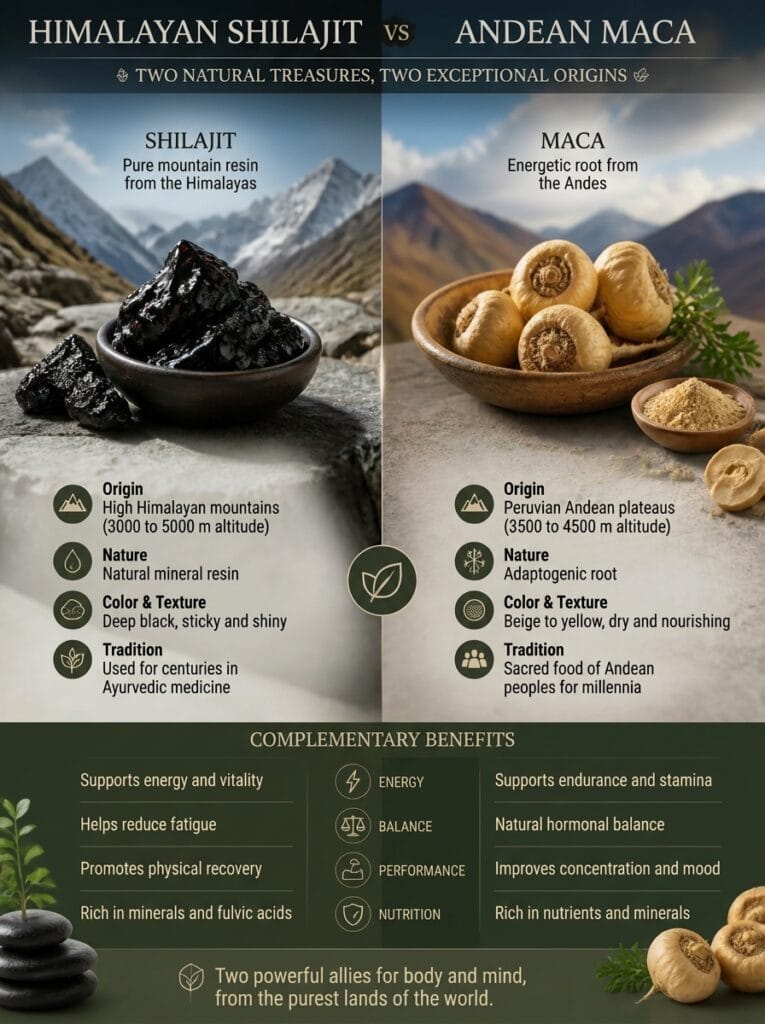
Shilajit is a complex substance that oozes from rock walls in high-altitude areas, notably in the Himalayas, but also in some regions of the Altai. It results from slow transformation of plant and microbial matter compressed over centuries. This natural maturation explains its resin texture, dark color, and richness in organo-mineral compounds.
In traditional Indian medicine, Shilajit is described as a rasayana, providing overall vitality support. Its profile also intrigues modern research, as it is neither a simple plant nor a classic food. To understand its uses, it must be considered as a biologically active mineral concentrate, hence the particular attention to its purification and quality.
Maca: adaptogenic root from the high Andean plateaus of Peru
Maca is a root cultivated for centuries in the Andes at very high altitude, sometimes beyond 3,500 to 4,000 meters. Populations of the Peruvian Andes traditionally use it as a tonic food, notably to support energy, cold resistance, and fertility of both livestock and humans. Its nature is therefore much more nutritional than that of Shilajit.
This root belongs to the Brassicaceae family. Its earthy and malty taste may surprise, but it integrates easily in powder or capsule form. When someone seeks support that is more nutritional than mineral, with a noticeable effect on functional fatigue and libido, Maca logically draws attention.
The common energetic point from extreme environments
Their great common point lies in their birth in hostile environments: altitude, cold, intense solar radiation, poor soils, high environmental pressure. These extreme conditions seem to favor interesting bioactive profiles. This also fuels their reputation as supporters of energy and physical resistance.
Shilajit and Maca do not play the same tune. They do, however, converge on a simple idea: helping the body better cope with daily stresses. For an active reader, overwhelmed parent, or amateur athlete, this shared goal is real, even if the mechanisms differ significantly.
Distinct nutritional composition of Shilajit and Maca
Richness in fulvic acid and essential minerals of Shilajit
Shilajit is mainly sought after for its content in fulvic acid, a humic compound capable of facilitating the transport of certain nutrients and improving cellular absorption. Depending on processes and origins, levels can vary widely, hence the interest in standardized products. Shilajit also provides minerals in ionic form, such as iron, zinc, magnesium, and calcium.
This composition explains why Shilajit is less of a caloric “superfood” and more of a deep functional support. Its fulvic acid is regularly cited in studies on mitochondrial activity and cellular exchanges. A publication by Carrasco-Gallardo et al., 2012, in International Journal of Alzheimer’s Disease, mentioned the neuroprotective potential of fulvic substances, with caution, of course:
“fulvic acid may block tau self-aggregation” (https://pmc.ncbi.nlm.nih.gov/articles/PMC3296184/). This does not constitute a treatment but opens a rational path.
Complex carbohydrates, amino acids, and vitamins of Maca
Maca has a quite different profile. It contains complex carbohydrates that provide useful energy during intense days, as well as amino acids, alkaloids, glucosinolates, flavonoids, and vitamins B, C, and E. Its perceived effect is sometimes faster because it also acts as a tonic food, which appeals greatly to people prone to seasonal fatigue.
Maca is not a stimulant in the sense of strong coffee. Its interest lies more in progressive metabolic support, with better tolerance when gelatinized. For some active people, a small morning dose suffices to improve the feeling of available energy without excessive nervousness, differentiating it from classic stimulants.
Specific antioxidant and adaptogenic properties
Shilajit and Maca both contain compounds with protective effects, but their profiles are not superimposable. The first concentrates humic derivatives and bioactive fractions associated with antioxidant properties, while the second relies more on its flavonoids and plant metabolites. On the ground, this may translate into different feelings regarding resistance to fatigue, stress, and loss of tone.
Maca is frequently described as an adaptogenic plant, even if this category remains more traditional than regulatory. Shilajit, on the other hand, appears more as a metabolic and mineral support. To compare usefully, a table is better than a slogan.
| Criterion | Shilajit | Maca |
|---|---|---|
| Nature | Organic mineral resin | Food root |
| Major origin | Himalayas, Altai | Andes of Peru |
| Key compounds | Fulvic acid, dibenzo-alpha-pyrones, minerals | Complex carbohydrates, amino acids, flavonoids, vitamins |
| Common feeling | Durable energy, deep support | Faster nutritional energy |
| Sought-after strengths | Testosterone, cognition, endurance | Libido, mood, fertility |
Effects of Shilajit and Maca on energy and vitality
Rapid and nutritional energy stimulation by Maca
For many users, Maca is chosen to support energy from the first weeks. Its carbohydrate and micronutritional profile explains this sensation. It may suit people who already wake up exhausted, active people chaining work and sports, or those going through a phase of decreased motivation.
Take Élise’s case, 39 years old, an executive and weekend runner. When sleep is mediocre and days are getting longer, she looks for a boost without nervousness. Maca gives her a sensation of more available fuel, with better endurance during long sessions. This type of use remains empirical but well reflects its reputation as a nutritional energy support.
Durable energy and mitochondrial action of Shilajit
Shilajit stands out by a more discreet action at first, then more profound. Several authors have explored its interest in mitochondrial function, these cellular powerhouses producing ATP, thus energy usable by the body. Ghosal et al. had already drawn attention to dibenzo-alpha-pyrones and their role in energy metabolism; later reviews have strengthened this mechanistic hypothesis.
For people who describe a “background” decrease in tone, a feeling of wear, or difficulty maintaining endurance over time, Shilajit is sometimes more relevant. This is also a reason why some athletes are interested in it, complementing proper sleep, dense nutrition, and a coherent recovery strategy. For further reading on sports use, the dossier on the benefits of Shilajit in bodybuilding provides practical markers.
Impact on libido, fertility, and hormonal health
Tonic and hormonal effects of Shilajit on testosterone
Shilajit is regularly associated with male hormonal support, particularly testosterone. A randomized study published in Andrologia in 2016 observed, after 90 days of purified Shilajit, a significant increase in total and free testosterone in healthy men aged 45 to 55. The signal is interesting but does not justify self-prescription in case of proven hormonal disorder.
This point matters for libido, motivation, endurance, and sometimes body composition. However, it should be recalled that a decrease in testosterone can have multiple causes: insufficient sleep, overweight, medication, alcohol, sleep apnea, or endocrine pathology. Shilajit never replaces a serious medical assessment when the situation persists.
Maca’s ability to stimulate libido and sexual endurance
Maca is probably better known to the public for libido. Several small clinical trials have suggested a positive effect on sexual desire after a few weeks. A review published in BMC Complementary and Alternative Medicine in 2010 showed limited but encouraging evidence. The mechanism does not seem to operate directly through an increase in testosterone, giving it a particular action.
In men, Maca is also cited for its potential interest in fertility, particularly certain sperm parameters. Again, the literature is not uniform, but consistent enough to justify its place in a holistic approach. For many couples, the issue is not only libido but also sexual endurance, confidence, and regularity of desire.
Compared circulatory and hormonal benefits
Shilajit may be interesting for its overall tonic action, possible influence on testosterone, and support of circulation via better cellular vitality. Maca, meanwhile, acts more on desire, hormonal comfort, and perception of tone. Regarding fertility, the two do not replace each other: Shilajit speaks more to the androgenic male context, Maca stands out for its versatility on libido and overall balance.
In women, Maca enjoys particular interest during periods of hormonal variation, although responses are very individual. Shilajit can also have its place, but priority remains tolerance, medical context, and the quality of the chosen product. When the question concerns fertility, medical follow-up is the most rational path.
Shilajit or Maca?
Quickly compare the two according to your priorities: energy, libido, fertility, testosterone, stress, memory, sleep, practicality, action delay, and target profile.
Choose your priority
The table below helps you identify the plant or substance generally most cited according to the targeted need. This does not replace medical advice.
Which profile suits you best?
Comparative table Shilajit vs Maca
Click on a row to get a quick insight.
| Criterion | Shilajit | Maca | Quick reading |
|---|
Selected criterion detail
Decision aid
Note on neutrality
This comparator presents general trends often mentioned in popular literature and traditional uses. Effects vary depending on product quality, dose, regularity, individual constitution, and health context.
Stress management, immune system, and cognitive functions
Soothing effects of Maca on mood and stress
When the main topic becomes mood, mental overload, and stress, Maca seduces with its gentleness. It does not anesthetize emotions, but some people report better stability and a feeling of “cleaner” energy, less brusque. In women undergoing hormonal transition, some studies have observed an interesting subjective well-being, without turning Maca into a universal solution.
This action probably works through several pathways: nutritional support, better tone, influence on the neuroendocrine axis, and reduction in the perception of stress. For those who poorly tolerate stimulants, Maca can be a gentler option. Its interest then makes sense in a broader routine: proper breakfast, daily walk, morning light, and regular sleep schedules.
Deep nerve and endocrine strengthening by Shilajit
Shilajit acts on a deeper register. Its fulvic acid, bioactive fractions, and minerals contribute to a more stable metabolic terrain, which may help endure physical and nervous stress better. Feedback converges on better resistance to exhaustion when taken for several weeks, especially in profiles that “push to the limit.”
The link between stress, the endocrine system, and testosterone decline is well established. When cortisol remains high too long, energy, libido, and concentration eventually decrease. In this context, Shilajit does not replace lifestyle but can become coherent support for strengthening basic resilience.
Contributions to immunity, cognition, and sleep quality
Maca and Shilajit each contribute in their own way to overall robustness. Their richness in protective compounds and antioxidants can support the body’s defenses, especially when a period of prolonged stress erodes reserves. The nuance remains crucial: this is about supporting the system, not therapeutic promises.
For many readers, real interest is measured on very concrete indicators: fewer energy slumps, better mental clarity, clearer awakening, more stable energy. Shilajit is generally preferred when the goal touches more on cognition and intellectual endurance; Maca when the main need concerns mood and daily availability.
Improvement in memory and concentration
Shilajit attracts attention for memory and concentration thanks to fulvic acid and its possible mitochondrial support. For adults working a lot on screens, the difference sometimes shows less in immediate excitation than in more stable working memory and less fluctuating attention. Scientific caution remains necessary, but the biological rationale exists.
Maca, on its side, may indirectly help concentration by reducing the feeling of fatigue and supporting mood. A less depleted person manages priorities and mental load better. In this context, the best strategy depends on the profile: deep mental fog and background decrease with Shilajit, nervous weariness with need for tone for Maca.
Effects on restorative sleep
Neither Maca nor Shilajit are sleeping aids. Yet some people sleep better when their daytime energy rises and stress decreases. Maca is sometimes better tolerated in the morning, whereas Shilajit can be taken early in the day or at noon depending on individual sensitivity.
The true benefit on sleep is indirect: better nervous stability, fewer energy dips, less irritability, and better adaptation to effort. A failing memory, decreasing libido, and insufficient testosterone are often worsened by poor sleep. Sleep thus remains the foundation on which these supplements may or may not make a difference.
Quality, origin, and purity of Shilajit and Maca: essential criteria
Importance of purified and traceable Shilajit in laboratory
The most critical point concerns Shilajit. Its popularity has led to a mixed market, with poorly purified, cut, or contaminated resins. A true Shilajit must be lab-tested for heavy metals, microbiological contaminants, and ideally standardized in fulvic acid. To better spot these criteria, this guide on how to choose quality Shilajit can serve as a useful basis.
Form also matters. Some prefer resin, others capsules for practicality. The comparison between Shilajit resin or capsules helps decide based on actual use. To check for warnings, you can also consult the potential dangers of Shilajit, with a useful look at poorly controlled products.
Favor organic Maca cultivated at altitude and gelatinized
For Maca, the main challenge is agricultural origin. Organic cultivation at high altitude, ideally in the Andes, remains preferable. Gelatinized form should also be favored, as it improves digestibility and sometimes concentrates practical use better, especially for people sensitive to intestinal discomfort.
The color of Maca can also guide use: yellow for versatile use, red sometimes cited for female comfort, black for performance or memory in some traditions and preclinical studies. These distinctions should not be fetishized but can guide a more targeted first trial.
Risks of processed and poorly controlled products
A mediocre product can ruin the interest of both options. An ultra-processed Maca, enriched with sugars, or a Shilajit without certificate of analysis expose to loss of efficacy or real risks. Before buying, check origin, tests, manufacturing mode, and coherence of promises.
Some comparative resources can help orient, such as this Shilajit brand comparison, this detailed review on Shilajit Wellness, or this report on Natural Shilajit. If you like exploring the ecosystem of the topic, the dedicated Shilajit site map can also save you time.
Synergy, precautions and choice between Shilajit and Maca for vitality
Energizing and hormonal complementarity of Shilajit and Maca
Opposing Shilajit and Maca is not always relevant. Their synergy can be interesting when one seeks at the same time background energy, better tone, more stable libido, and fertility support. Shilajit brings its remineralizing, mitochondrial, and androgenic side; Maca adds its more nutritional tonic effect and action on desire.
For an amateur athlete in a phase of professional overload, this synergy can be logical: Maca in the morning for energy, Shilajit in low dose for lasting hold. For a man over 40, the combination can also be considered to support testosterone, libido, and endurance, subject to a suitable constitution.
Progressive consumption and caution on dosages
The best rule remains progression. For Maca, many start between 1.5 and 3 g per day depending on form. For Shilajit, commercial dosages vary, but a small amount of purified resin or a standardized capsule dose suffices to test tolerance. Increasing too quickly does not necessarily bring more energy.
Over 2 to 4 weeks, observe three simple markers:
the stability of energy during the day,
the evolution of libido and endurance,
the level of stress, sleep, and digestive comfort.
This concrete observation is better than unrealistic expectations. A good synergy builds by adjustment, not accumulation.
Contraindications, interactions, and indispensable medical advice
Shilajit requires caution in case of iron excess or hemochromatosis, as it may contain iron and act on overall metabolism. Maca needs particular attention in case of thyroid disorders, especially if overall diet is already high in crucifers and if the product is poorly processed. Pregnancy, breastfeeding, hormonal treatment, anticoagulants, chronic diseases: medical advice is essential.
When a symptom touches fertility, testosterone decline, libido drop, severe fatigue, or intense stress, a supplement must never delay diagnosis. This is a major safety point and also what differentiates intelligent use from pure impulsive purchase.
Choice criteria according to vitality goals and individual profiles
If your priority is lasting energy, cognitive support, a deeper reserve feeling, or targeted interest in testosterone, Shilajit makes more sense. If you seek a more nutritional boost, mood support, libido, fertility, or better digestive comfort, Maca takes the lead. For some people, the combination of the two creates a convincing balance.
One last practical marker can help:
| Your main goal | Most coherent option | Why |
|---|---|---|
| Durable and deep energy | Shilajit | Mitochondrial support, minerals, foundational action |
| Quick daily tone boost | Maca | Nutritional profile, complex carbohydrates, good tolerance |
| Testosterone and male vitality | Shilajit | Clearer clinical data on testosterone |
| Libido and sexual desire | Maca | Strong tradition and encouraging human trials |
| Fertility and overall support | Maca or combination | More versatile approach according to profile |
| Stress and nervous wear | Maca or Shilajit | Gentleness of the first, depth of the second |
If you still hesitate, start by identifying your main need for 30 days: lack of energy, lowered libido, fragility to stress, fertility goal, or support of testosterone. This simple sorting avoids taking a “trendy” supplement instead of the most suitable one.
Is Shilajit stronger than Maca for energy?
Not necessarily stronger, but different. Shilajit targets more durable and deep energy, linked to mitochondrial and mineral support. Maca provides a more nutritional tone, sometimes felt faster. The right choice therefore depends on the type of fatigue you experience.
Can Shilajit and Maca be combined in the same routine?
Yes, the combination is possible in many adults, with progressive dose increase. This synergy can be interesting to support energy, libido, endurance, and hormonal balance. In case of pathology, treatment, or doubt about tolerance, seek advice from a healthcare professional.
Does Maca increase testosterone?
Current data mainly suggest an effect on libido and sexual well-being, without systematic increase in testosterone. Conversely, Shilajit has more precise clinical results on testosterone in some men. This never replaces an assessment in case of persistent hormonal symptoms.
Which supplement to choose for fertility?
For fertility, the answer depends on profile. Maca is often chosen for its global support and traditional use history. Shilajit may be relevant in men when the question of testosterone, endurance, or background vitality arises. Medical accompaniment is still recommended for prolonged conception plans.
What precautions to take before buying?
Check traceability, lab analyses, and product form. For Shilajit, demand serious purification and contaminant control. For Maca, prioritize organic Andean origin and, if possible, gelatinized form. Quality determines both expected efficacy and safety of use.

As a wellness consultant with over 10 years of experience, I help individuals and businesses incorporate natural health practices to improve their quality of life on a daily basis.