
In Brief
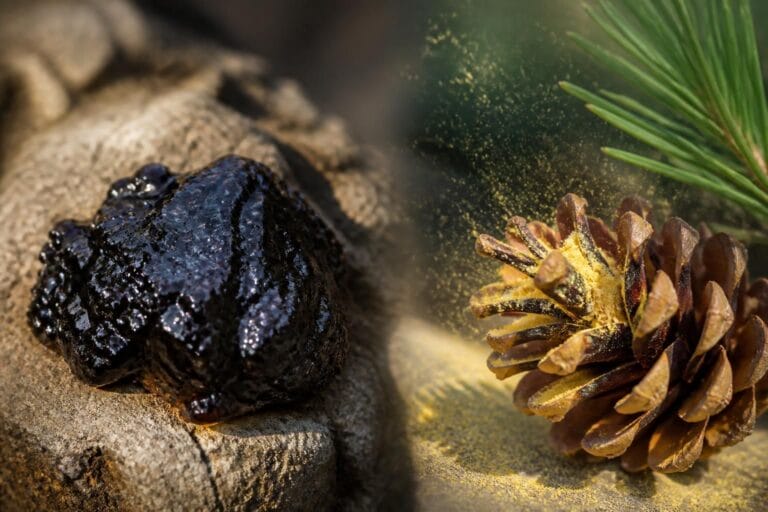
Shilajit and pine pollen are two very different natural supplements by their origin, composition, and target use.
Shilajit, sourced from mountains, stands out for its richness in fulvic acid, humic substances, and minerals, with an action mainly linked to energy, stress adaptation, and overall condition.
Wild pine pollen concentrates phytoandrogens, vitamins, enzymes, and amino acids, with a more marked interest for testosterone, libido, and male hormonal support.
Shilajit has a more versatile profile, relevant for both men and women, whereas pine pollen remains more targeted.
Modern data suggest an effect of Shilajit on mitochondrial function and endogenous testosterone production, while pine pollen acts more through its phytoandrogens with sometimes a faster perception.
Product quality remains crucial: purity, heavy metal analyses, traceability, and manufacturer transparency must outweigh marketing.
Between mineral resin from high mountains and golden dust from wild pines, the choice between Shilajit and pine pollen is not just a simple natural preference. Both products often circulate in the same conversations around vitality, recovery, and male balance, but their physiological profiles are neither interchangeable nor equivalent. One acts more as a metabolic foundation and adaptogen, the other as a more targeted lever on the androgenic field.
For a person looking to better manage stress, regain energy, or support regular sports practice, Shilajit often offers a more complete base. For those primarily aiming at libido, tone, or male hormonal support, pine pollen deserves careful study, provided precautions are respected. The truly good choice depends less on displayed promises than on personal context, tolerance level, and the actual quality of the supplement.
Natural origin and chemical composition of Shilajit: a mountain treasure
Shilajit is an organo-mineral substance that oozes from rocks at high altitudes, notably in the Himalayas, Altai, or Caucasus, due to temperature variations. It results from a very slow transformation of plant and microbial matter, compressed for centuries. This origin explains its special status in traditional medicines, where it has long been associated with strength, endurance, and longevity.
In practice, not all Shilajit extracts are equal. Its reputation is linked to a complex matrix, difficult to reproduce artificially, which is why it’s important to refer to serious criteria to choose quality Shilajit. This point changes everything, as a poorly purified product can negate the expected physiological benefits.
Formation and richness in fulvic, humic acids, and minerals
The value of Shilajit is primarily based on its content of fulvic acid, humic acids, and minerals in ionic form. The fulvic acid acts as a transport and chelation molecule, capable of improving the bioavailability of certain nutrients. Analyses published in the Journal of Ethnopharmacology also reminded that Shilajit contains dibenzo-alpha-pyrones and various trace elements.
This chemical profile underpins modern interest in Shilajit. When an amateur athlete increases training load, they’re not just seeking a “boost,” but better management of energy and recovery. It is precisely here that the richness in minerals and fulvic acid gives Shilajit a very different identity from a classic stimulant.
Adaptogenic properties of Shilajit: hormonal balance and cellular energy
Shilajit is often described as an adaptogenic support, meaning oriented towards better adaptation capacity against physical and nervous constraints. Its interest is not limited to the male sphere. In some people, it fits better into a global revitalization strategy than into a raw performance logic.
A clinical study published in Andrologia in 2016 (Authors: Pandit S, Biswas S, Jana U, De RK, Mukhopadhyay SC, Biswas TK.) observed that standardized supplementation of Shilajit for 90 days in healthy men was associated with an increase in total and free testosterone.
The study’s reported formula is frequently cited as: “processed shilajit supplementation significantly increased total testosterone.” Such data is interesting but should not be interpreted as a universal guarantee.
Role of antioxidants in stress resistance
Shilajit also contains antioxidants and compounds likely to support mitochondria, the cellular powerhouses that condition energy production. When sleep is shortened, training intensifies, or mental stress accumulates, this mitochondrial terrain becomes central. This is a coherent path with its traditional use as a general tonic.
To go further on its practical uses, several useful references exist on the benefits of Shilajit. The key idea remains simple: Shilajit does not replace good lifestyle habits or medical follow-up, but it can complement a foundational strategy.
Wild pine pollen: composition and targeted benefits for men
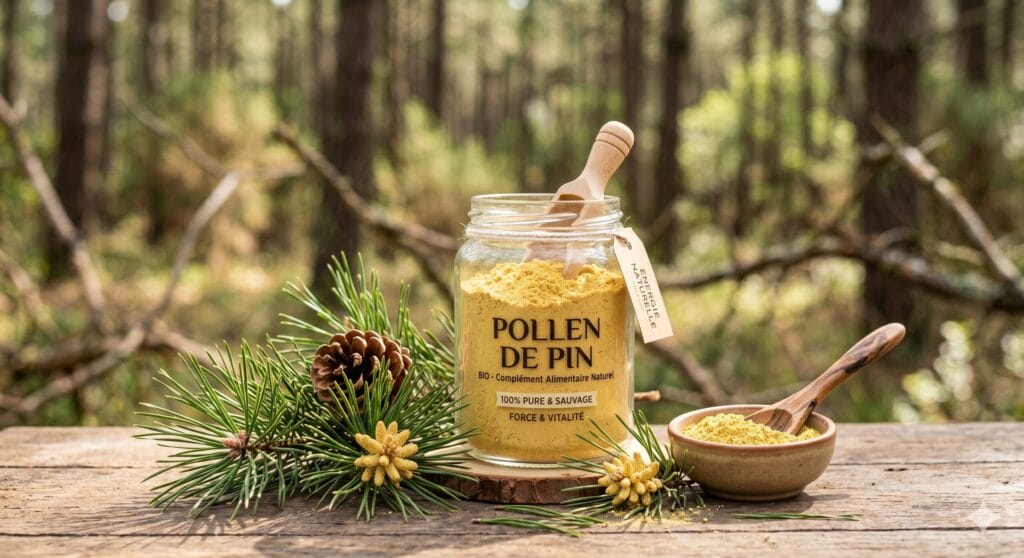
Wild pine pollen comes from the male catkins of certain pine species, harvested and sifted. Its history is rooted in several Asian traditions where it was used as a tonic. Unlike Shilajit, it does not come from the mineral world, but from a rich and fragile plant matrix, more sensitive to season, harvesting environment, and conservation.
Its current interest lies in its reputation for supporting virility and physical tone. Again, a nuanced reading must be kept: pine pollen may be relevant for certain profiles, but it does not constitute a universal solution for decline in form or a measured drop in testosterone.
Concentration in phytoandrogens, vitamins, and essential enzymes
Pine pollen contains amino acids, B-group vitamins, polysaccharides, enzymes, and especially phytoandrogens. These compounds explain its image as targeted hormonal support. Several manufacturers emphasize the presence of small amounts of substances close to androgens, with a more or less marked mimetic action depending on extracts.
Its logic differs from that of Shilajit. Where Shilajit works more on the overall terrain, pine pollen is often sought for a more perceptible response on tone and hormonal support. It is precisely this difference in philosophy that helps choosing without confusing roles.
Effects on sexual vitality, testosterone, and muscle growth
In usage feedback, pine pollen is frequently associated with libido, physical motivation, and the feeling of vigor. Its effect on testosterone is debated, with human evidence even more limited than for Shilajit. However, its rich profile in phytoandrogens supports a credible functional backing, especially for men seeking a boost in sexual vitality.
For bodybuilding practitioners, the interest mainly concerns the hormonal environment, not a magical mass gain. If your goal involves recovery and endurance, Shilajit in bodybuilding generally offers a more stable approach.
Key differences between Shilajit and pine pollen: uses and effectiveness profiles
Shilajit: a versatile supplement for men and women
Shilajit stands out for its versatility. It may interest a tired man, a woman under high mental load, or an athlete seeking better management of energy. This wide range explains why Shilajit goes beyond just testosterone.
In the female field, some readers also consult references dedicated to Shilajit for women. This versatility is its real strength: it fits into a global strategy rather than a single hormonal promise.
Pine pollen: a specifically masculine hormonal action
Pine pollen mainly speaks to men who want to target libido, tone, and the feeling of physiological power. Its phytoandrogens direct its use toward a more masculine register. This specialization can be relevant but also reduces its interest in profiles seeking broader metabolic or recovery support.
In other words, if the main goal is overall reactivation, Shilajit often retains the advantage. If the absolute priority is the male hormonal sphere, pine pollen becomes more logical to test.
Comparison of mechanisms of action and duration of effects
| Criterion | Shilajit | Pine pollen |
|---|---|---|
| Origin | Mountain organo-mineral substance | Plant pollen from wild pines |
| Dominant mechanism | Mitochondrial support, metabolic terrain, endogenous testosterone production | Mimicry via phytoandrogens |
| Audience | Men and women | Mostly male |
| Perceived timing | More gradual, often longer-lasting | Sometimes more immediate, sometimes less lasting |
This distinction greatly helps in practice. Shilajit may require a few weeks before energy, recovery, or general stability are better perceived. Pine pollen is sometimes described as more “direct,” but also less regular from one user to another.
Specific benefits and indications of Shilajit for natural health
Improvement of cellular energy and immune support
Shilajit is often chosen when the primary goal is cellular energy. By supporting mitochondrial function, it can accompany periods of diffuse fatigue from sustained training or gradual recovery after an episode of overwork. Several reviews, including a 2012 review in the International Journal of Alzheimer’s Disease, highlighted its global biological potential while calling for more robust clinical trials.
Its interest goes beyond performance. Shilajit is also mentioned in approaches to support the immune terrain and resilience. For more targeted male needs, the resource on benefits of Shilajit for men provides a useful complement.
Stress management and optimized muscle recovery
In active people, Shilajit is often better tolerated when integrated in low progressive doses. A common case: a man in his forties who runs, works a lot, and sleeps badly does not seek aggressive stimulation, but better stability. Shilajit precisely responds to this foundational logic, with an action on energy and recovery.
Concrete details on forms exist, notably to compare Shilajit resin or capsules. This detail matters, as compliance and practicality often change regularity of intake.
Hormonal virtues and male vitality brought by pine pollen
Boosting libido and natural testosterone stimulation
Pine pollen addresses especially men who feel a drop in sexual tone, lower motivation, or less stable libido. Its image is based on the idea of support to natural testosterone, even if human clinical data remain still limited. This caution does not remove its practical interest but invites not to confuse subjective feeling and medical proof.
The useful benchmark is to observe whether the drop in form is mainly hormonal or more global. If fatigue, stress, and poor recovery dominate, Shilajit often retains a better relevance-tolerance ratio.
Support for muscle mass and overall toning
Pine pollen is also sought to support strength training and perceived muscle density. This does not mean it automatically increases lean mass, but it can accompany a favorable terrain when nutrition, sleep, and progressive overload are already in place. Without these basics, neither pine pollen nor Shilajit compensate for fundamental errors.
The useful question is therefore not “which product is stronger?” but “which product fits my real need?”. This refocus avoids many disappointments.
Precautions and recommended dosages for Shilajit and pine pollen
Contraindications and possible side effects
For Shilajit, dosages frequently encountered range from about 250 to 500 mg per day for a standardized purified extract, sometimes more depending on form and manufacturer. For pine pollen, uses vary widely, often between 500 mg and 2 g per day depending on powder, extract, or tincture. A progressive introduction remains the best approach.
Avoid self-supplementation without professional advice in case of hormonal treatment, anticoagulant, or chronic pathology.
Caution in pregnant or breastfeeding women, due to insufficient data.
Monitor digestive and allergic tolerance from the first days.
Risks linked to Shilajit: digestive troubles and precautions
Poor quality Shilajit may expose to contaminants or insufficient purification. Reported side effects are mostly mild: digestive discomfort, nausea, altered stools, sometimes sensation of heat. For a more complete overview, the file on dangers of Shilajit recalls useful caution points.
The safest rule is to start low, especially if you already take other supplements targeting testosterone or energy. Gradual increase protects better than enthusiasm.
Pine pollen and allergic reactions: necessary vigilance
The main risk of pine pollen remains allergic. In people sensitive to pollens, caution is obvious, especially with raw powders. A very small dose test, ideally over several days, helps to evaluate tolerance before considering a progressive increase.
This vigilance is even more justified as the felt promise on libido or testosterone never outweighs a hypersensitivity reaction. When the terrain is allergic, it’s better to favor other paths.
Choosing quality supplements: certifications, transparency, and counterfeit risk
Essential criteria to guarantee purity and effectiveness
Quality determines a large part of observed results. For Shilajit, look for independent analyses on heavy metals, microbiological purity, and fulvic acid content. For pine pollen, botanical traceability, harvesting method, and absence of environmental contaminants are just as important.
| Control Point | Why it is useful |
|---|---|
| Certificate of analysis | Verifies purity, contaminants, and standardization |
| Clearly indicated origin | Reduces risk of counterfeiting or adulteration |
| Transparent dosage | Allows real comparison between products |
| Appropriate galenic form | Improves compliance and tolerance |
If you explore several related uses of Shilajit, from metabolism to weight, a detour by Shilajit and weight loss or by the Shilajit Essentials site map can help to better set realistic expectations. The best protection against counterfeits remains a critical reading of evidence.
Advantages of a Shilajit and pine pollen synergy for hormonal health
Combining Shilajit and pine pollen can make sense for some men, especially when the need mixes low energy, slow recovery, and search for hormonal tone. Shilajit then serves as a metabolic base, while pine pollen provides a more targeted axis on testosterone. This combination should however be introduced progressively, never all at once.
In practice, starting with Shilajit alone for two to three weeks often allows evaluating the body’s response. Pine pollen can then be added in small doses if the priority remains male hormonal support. This measured approach is often wiser than a rapid stacking of supplements.
Does Shilajit really increase testosterone?
Clinical data exist, notably a study published in Andrologia in 2016 showing an increase in total and free testosterone in men supplemented with a purified Shilajit extract for 90 days. This remains an interesting result but not an individual guarantee.
Is pine pollen reserved for men?
Its use is mainly oriented toward male needs due to its phytoandrogens and its image linked to libido, tone, and testosterone. Shilajit is generally considered more versatile for varied profiles.
Which supplement to choose in case of fatigue and chronic stress?
When the main complaint concerns energy drop, recovery, stress, and general endurance, Shilajit is often the most coherent choice. If the demand is mainly hormonal and sexual, pine pollen can be considered with caution.
Can Shilajit and pine pollen be combined?
Yes, for some male profiles, but it is better to first introduce Shilajit alone, then gradually add pine pollen to observe digestive, nervous, and allergic tolerance. A health professional can help secure this strategy.

As a wellness consultant with over 10 years of experience, I help individuals and businesses incorporate natural health practices to improve their quality of life on a daily basis.