
In Brief
Shilajit is a natural substance originating from rocky outcrops, known for its richness in minerals and fulvic acid.
No clinical study has directly demonstrated hair regrowth thanks to Shilajit, but skin studies show effects on microcirculation, vascularization and the cellular environment.
Its relevance for hair is based on indirect but credible mechanisms: improved nutritional supply to the follicle, energy support, action on oxidative stress and inflammation.
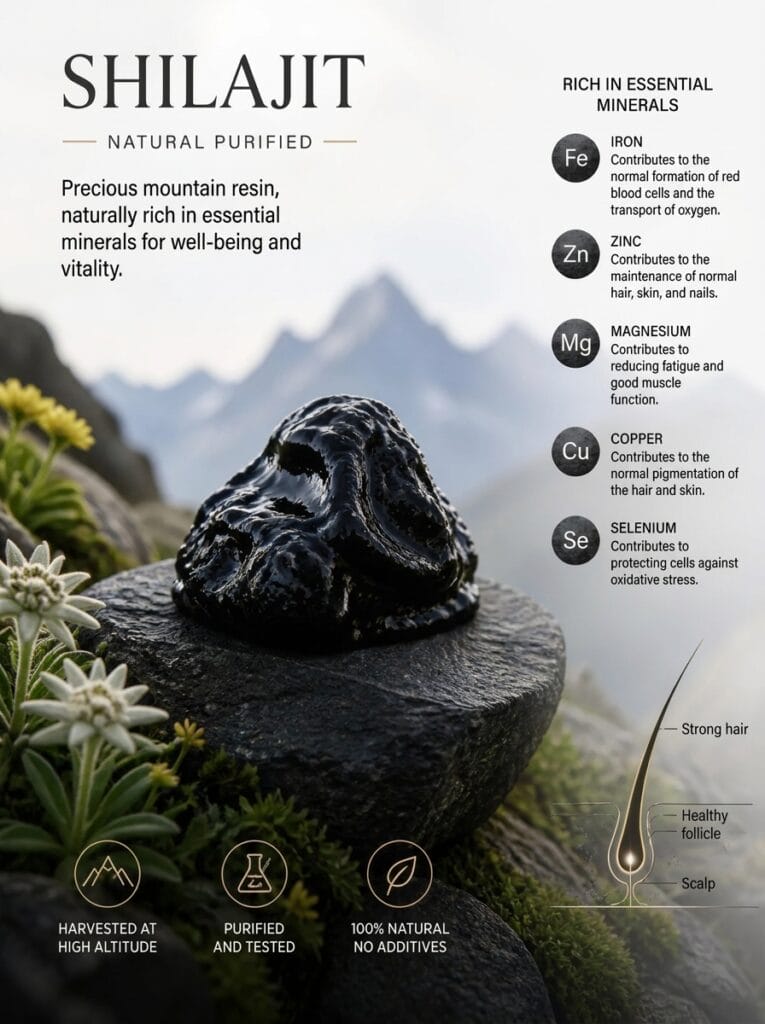
Zinc, iron, copper, magnesium and sulfur contribute to fiber quality, keratin, oxygenation and pigmentation.
Oral use is commonly around 250 mg twice a day for 3 to 6 months, possibly with a well-diluted hair mask as a complement.
Shilajit does not replace a medical workup in the case of unusual, sudden or localized hair loss.
When hair loss becomes established, many look for a natural active ingredient capable of acting without shocking the body. Shilajit draws attention for a simple reason: it is not a superficial cosmetic oil, but an organic-mineral substance studied for its effects on cellular energy, circulation and oxidative balance. In other words, its potential interest does not concern visible hair alone, but the biological ground that allows the follicle to produce a more robust fiber.
The subject nonetheless deserves nuance. Shilajit is neither a medicine against hair loss nor a miracle promise of rapid regrowth. However, the available data, usage feedback and physiological rationale point in the same direction: by improving certain essential scalp parameters, it could support quality, strength and sometimes hair density in people whose nutritional or oxidative environment is unfavorable. It is precisely this gray area, between clinical caution and real potential, that needs to be clarified.
Natural origin and mineral composition of Shilajit beneficial for hair
Shilajit is formed slowly from plant and microbial matter transformed over centuries in mountainous areas. This dark, resinous and complex exudate is harvested and then purified. Its traditional reputation comes from its unusual bioactive profile, combining organic matter, trace elements and transport compounds such as fulvic acid.
For hair, this composition is not trivial. The hair follicle is among the most metabolically active tissues in the body. It needs oxygen, adequate blood flow and a regular supply of minerals. When any of these parameters decline, the hair cycle can shorten, the fiber can thin and hair loss can become more noticeable. Shilajit is therefore of interest less as a direct “hair booster” than as foundational support.
Himalayan Shilajit: an organic source rich in essential minerals
Shilajit from the Himalayas is the most cited, notably because this area concentrates geological formations reputed for their mineral richness. Traces of zinc, iron, copper, magnesium and sulfur are found there, with other components added depending on altitude, bedrock and purification quality. The whole issue here lies in purity: a good product concentrates useful elements without accumulating contaminants.
For hair, these nutrients have concrete roles. Zinc is involved in cell division, iron in oxygen transport, copper in certain pigmentation pathways, magnesium in enzymatic reactions, and sulfur in keratin architecture. When a supplement concentrates these supports in a naturally complex matrix, it becomes logical to consider it for follicle health, provided expectations remain realistic.
Shilajit does not act like an instant cosmetic: its interest mainly lies in supporting the vascular, nutritional and oxidative ground of the hair follicle.
Key role of fulvic acid in the bioavailability of hair nutrients
Fulvic acid is one of the most studied components of Shilajit. Its particularity lies in its ability to complex certain nutrients and promote their biological transport. This does not mean everything will be absorbed perfectly. It helps explain why this substance attracts so much interest in the wellness and supplement field.
For hair, the central idea is simple: the value of a supply depends not only on the amount ingested but also on its cellular availability. A poor intake of poorly assimilated minerals can leave the follicle struggling. Conversely, the fulvic acid in Shilajit could favor better use of certain cofactors useful for keratin synthesis and local metabolism. It’s a biochemical detail that often changes how one reads a supplement.
Impact of Shilajit on skin microperfusion and hair follicle health
Hair health strongly depends on the quality of exchanges at the scalp level. A properly supplied follicle more easily receives oxygen, amino acids and micronutrients. When local perfusion slows, the environment becomes less favorable to regular growth. This is where Shilajit becomes interesting, as several data concern the skin and tissue vascularization.
The parallel with age-related hair changes is coherent. With age, the follicular environment can lose efficiency: less dynamic circulation, low-grade chronic inflammatory stress, less sustained mitochondrial activity. Shilajit is sometimes considered as long-term support for these deep functions, rather than as a simple “anti-hair loss” product.
Scientific studies on microcirculation improvement by Shilajit
A study often cited is that of Das et al., 2019, published on a skin model. The authors observed improvement in microperfusion and modulation of genes associated with vascular growth and collagen synthesis. The exact formula reported in the study’s comments emphasizes improved skin functionality and parameters related to tissue repair. This does not directly measure hair regrowth, but the biological signal remains relevant for the follicle.
You can find the study summary through scientific databases such as PubMed and journals dedicated to bioactive compounds.
Study: “Skin Transcriptome of Middle-Aged Women Supplemented with Natural Shilajit” – https://pmc.ncbi.nlm.nih.gov/articles/PMC7027386/
Authors: Das A, Datta S, Rhea B, Sinha M, Veeraraghavan M, Gordillo G, Roy S.
Publication: 2019 (Journal of the American College of Nutrition)
The takeaway is cautious: there is no definitive clinical evidence showing that Shilajit causes hair to regrow. However, an improvement in microcirculation and markers of skin pro-repair can reasonably be considered favorable to the hair ecosystem.
In practice, this is indeed what many user reports describe:
- Less breakage,
- Stronger fiber,
- Feeling of a “better nourished” scalp,
- Sometimes a reduction in diffuse hair loss after several months.
These testimonies do not replace clinical trials, but their consistency with known mechanisms is worth noting.
Parameter | What the data suggest about Shilajit | Potential interest for hair |
|---|---|---|
Skin microperfusion | Improvement observed in experimental work | Better supply to the follicle and support of the hair cycle |
Gene expression | Activation of pathways related to vascular growth and collagen | More favorable scalp environment |
Oxidative stress | Protective action via compounds with antioxidant activity | Protection against premature follicle aging |
Biological mechanisms essential for optimal hair growth
To understand whether Shilajit is beneficial or harmful, you must go back to basics. Healthy hair is never the result of a single nutrient. It depends on a complete system: local perfusion, nutrient availability, cellular energy activity and low levels of oxidative assaults. If one link fails, fiber production slows or degrades.
This perspective avoids shortcuts. When someone suffers from hair loss, the problem can come from:
- A deficiency, a thyroid disorder,
- Postpartum,
- Severe stress,
- Inflammation
- Androgenetic alopecia.
Shilajit never replaces this necessary triage. However, it can be integrated into the “terrain” part of a broader strategy.
Importance of scalp blood microcirculation
The microcirculation of the scalp is decisive. The hair bulb functions like a small, rapidly renewing factory. Without effective blood flow, the delivery of oxygen and substrates slows, which can translate into finer, less dense hair that is more prone to breakage.
Shilajit is not a medicinal vasodilator, but its possible action on tissue perfusion, added to its nutritional support, provides a solid physiological framework for its use. In sedentary, stressed or aging individuals, this logic is even more relevant. Scalp aging partly follows vascular aging: supporting circulation therefore protects the hair ground at the root.
Mineral supply and keratin synthesis for strong hair
Hair is mostly made of keratin, a protein whose production requires numerous cofactors. Shilajit naturally provides minerals useful to this mechanism.
Zinc is particularly involved in cell division and sebaceous gland regulation. A zinc deficiency can be accompanied by a more fragile fiber and diffuse hair loss.
Iron, for its part, conditions oxygen transport. When reserves drop, the follicle receives less of what it needs. This does not mean Shilajit will correct an iron deficiency by itself, but it fits into a broader reflection on micronutritional supply.
Sulfur, finally, contributes to disulfide bonds that give mechanical strength to hair. This architecture explains why some fibers seem more “elastic” and less brittle over time.
Influence of cellular energy and the local environment on hair quality
Hair production requires energy, therefore ATP. Shilajit is regularly studied for its interest in mitochondrial function and cellular vitality. In an endurance athlete, for example, you clearly see the difference between an organism that recovers well and one under chronic stress: dull skin, weaker nails, less vigorous hair. The follicle is no exception to this logic.
The local environment matters just as much. Low-grade inflammation, excess oxidized sebum, irritated skin, pollution, UV radiation and oxidative stress can accelerate follicular aging. Shilajit, thanks to its active compounds and antioxidants, appears interesting for cushioning this context. Again, the expected benefit is gradual, never dramatic overnight.
Shilajit support routine for hair
Estimate a coherent routine in a few clicks according to your hair profile. This tool is informative and does not replace medical advice, especially in cases of significant hair loss, persistent fatigue or suspected deficiency.
1) Describe your situation
All texts are easily modifiable in the script.
2) Personalized result
Choose your parameters then run the simulation.
—
- —
—
3) Quick tips to remember
Important note
This simulator offers an educational estimate around the theme “Shilajit and hair care: beneficial or harmful?”. It does not replace a healthcare professional. If you have sudden hair loss, patches, significant itching, pregnancy, ongoing treatment or a known condition, seek medical advice before any supplementation.
How Shilajit acts on hair follicle biology to improve hair health
Saying that Shilajit “makes hair grow” would be reductive. Its interest lies in a set of converging effects on follicle biology. It improves the ground more than it forces a result. This distinction is essential to avoid disappointment and to understand why evaluation must be done over several months.
A person experiencing hair loss after a period of stress, poor sleep and a depleted diet may sometimes observe gradual improvement with comprehensive support. In this context, Shilajit acts as one support among others: correcting deficits, better recovery, more stable follicular environment.
Combined action on vascularization and nutrient supply
The first lever of Shilajit concerns vascularization and microcirculation. If the skin tissue is better perfused, it distributes oxygen, amino acids and micronutrients more efficiently. The second lever is linked to minerals and fulvic acid, which may facilitate their biological availability. Together, these two dimensions create conditions more favorable to the hair cycle.
Concretely, this can translate into hair that appears more resistant to brushing, a fiber less “hollow” and a regrowth phase better tolerated after seasonal hair loss. Reports also mention an improvement in texture. This type of evolution is not spectacular, but it matches what is expected from well-formulated foundational support.
Antioxidant effects and protection against oxidative stress
The follicle is sensitive to oxidative stress. Free radicals can damage cell membranes, disrupt enzymatic activity and accelerate scalp aging. Shilajit has properties associated with the presence of antioxidants and organic fractions capable of modulating this environment.
This protection is particularly relevant for people exposed to chronic fatigue, smoking, pollution, UV or low-grade inflammation. Reducing this oxidative noise does not guarantee regrowth, but it potentially reduces one of the major barriers to hair quality. The issue is therefore biological, not cosmetic.
The logic of Shilajit for hair rests on three pillars: local circulation, nutrient availability and protection against chronic oxidative stress.
Specific role of Shilajit’s minerals in strengthening the hair fiber
Talking about Shilajit without detailing its trace elements would miss the point. Not all minerals have the same weight in hair biology, but each acts on a specific step. It is this complementarity that makes the matrix interesting, provided one does not confuse nutritional support with targeted treatment of a documented deficiency.
Zinc, iron, copper: essential functions for growth and pigmentation
Zinc is a major cofactor of cell proliferation. Cells of the hair bulb divide rapidly, which explains why an insufficient status can weaken growth. Zinc also contributes to skin balance and sebaceous gland function. For some people, this translates indirectly into a less dysregulated scalp.
Iron is essential for tissue oxygenation via hemoglobin. Low ferritin is a common reason for hair loss, especially in women. Shilajit contains iron, but a biological workup remains essential if deficiency is suspected. As for copper, it is involved in enzymes linked to pigmentation, which feeds interest in Shilajit in a global anti-aging approach, in connection with the link between Shilajit, collagen and youth.
Magnesium and sulfur: enzymatic regulation and mechanical resilience of hair
Magnesium acts as a regulator in many enzymatic reactions. A rapidly renewing tissue like the hair follicle depends on this metabolic fluidity. Even if the effect of magnesium from Shilajit on hair has not been isolated in clinical trials, its role in overall balance remains coherent.
Sulfur, meanwhile, deserves particular attention. It participates in keratin structure through disulfide bonds, which give hair its strength, shape and part of its mechanical resilience. When the fiber lacks firmness, it breaks faster and perceived hair loss sometimes seems more severe than it actually is. Strengthening hair matter therefore also changes the perception of the problem.
Component of Shilajit | Biological role | Potential impact on hair |
|---|---|---|
Zinc | Cell division, scalp balance | Support for growth and root quality |
Iron | Oxygen transport | Better follicle oxygenation |
Copper | Enzymes of pigmentation | Support for natural color |
Magnesium | Enzymatic regulation | Better metabolic environment |
Sulfur | Disulfide bonds of keratin | Stronger, less brittle fiber |
Fulvic acid in Shilajit: accelerator of mineral absorption for hair
Among Shilajit’s distinctive arguments, fulvic acid occupies a central place. Many supplements provide nutrients, but few have a matrix naturally designed as a biological carrier. This capacity to accompany explains part of Shilajit‘s interest for people seeking more systemic hair support.
Biological transport and improved hair bioavailability
Fulvic acid promotes the transport of compounds across certain biological interfaces and can improve the solubility of various elements. For hair, this potentially means that the minerals present in Shilajit are not just numbers on a label. They fit into a logic of more efficient use, which is particularly interesting when seeking progressive follicle support.
This uniqueness also explains why some users perceive more effects simply by changing product quality. Not all extracts are equal. If you compare different offers, analyses on purity and usage experience can be useful, for example via a comparison between different Shilajit references, detailed reviews on Natural Shilajit or feedback on Shilajit Wellness. For hair, the quality of the support counts almost as much as the idea of the supplement itself.
This notion of bioavailability is the hinge of the subject: Shilajit is not just a bunch of minerals, it is a biologically active matrix.
Antioxidant and anti-inflammatory properties of Shilajit against hair loss
Hair loss is not always linked to a single visible cause. In many cases, low-grade inflammation and excess oxidative stress maintain an unfavorable ground. The scalp ages, local oxygenation drops and the hair cycle loses regularity. This is one reason why Shilajit is thought of as supportive background rather than an immediate response.
Reduction of oxidative stress and scalp inflammation
Shilajit contains compounds associated with protective activity against oxidative stress. This action, combined with the presence of antioxidants, can help limit cellular damage on the scalp. In a long-term logic, this amounts to preserving an environment more favorable to follicle survival and activity.
The link with hair loss is plausible: less inflammation and fewer oxidative assaults potentially mean fewer unfavorable signals around the root. In people with a sensitive scalp, this can complement a gentle routine without harsh sulfates, without excessive heat and with better recovery hygiene. Shilajit does not cancel hormonal causes, but it can attenuate peripheral factors that worsen the situation.
A scalp that ages poorly loses perfusion, energy and oxidative stability; Shilajit could support these three axes progressively.
Practical use of Shilajit to promote hair health
The best way to use Shilajit for hair generally remains oral, because the goal targets circulation, internal supply and cellular balance. Topical application can complement, but it does not replace foundational work. To obtain a reliable benchmark, reason according to the hair cycle, therefore over several months, not a few days.
Recommended oral dosage and minimum duration of use
The most frequently cited dosage for general use is about 250 mg twice a day of purified Shilajit, ideally according to the manufacturer’s indications and a healthcare professional if you are being followed. A morning and late-day intake is often well tolerated. For hair, an evaluation window of 3 to 6 months is more relevant than a very short trial.
Daily dosage and duration for an observable hair effect
Why this timeframe? Because hair biology is slow. A reduction in hair loss or a texture improvement can emerge in a few weeks for some profiles, but a visible effect on mass or quality is mostly read by regrown length. To be concrete:
250 mg of Shilajit, twice a day, is a common reference point.
A minimum duration of 12 weeks helps assess tolerance and first changes.
Between 3 and 6 months, observation of hair is more pertinent given the hair cycle.
In case of pronounced hair loss, the supplement should accompany a nutritional and hormonal workup, not replace it.
When general fatigue dominates, some people combine Shilajit with other plants according to their profile, as detailed in the Shilajit and maca combination, the tribulus and Shilajit duo or the combination with pine pollen. These leads can interest overall terrain, but should not multiply intakes without logic or professional advice.
Topical application: nourishing hair mask recipes with Shilajit
Topical use of Shilajit aims mainly to complement a care routine. A simple hair mask can be prepared with a very small amount of purified resin diluted in a vegetable oil. The raw texture should never be applied directly to the scalp without dilution, especially if the skin is sensitive.
Practical recipe: mix a hazelnut-sized amount of jojoba or coconut oil with the equivalent of a grain of rice of Shilajit well dissolved in a few drops of warm water, then apply to lengths and lightly to the scalp for 15 to 20 minutes before shampooing. This hair mask can be done once a week. The goal is not to “make hair grow” instantly, but to support comfort and surface nutrition.
Precautions and advice before using Shilajit for hair growth
Shilajit is generally considered promising and well tolerated when purified and used correctly. However, talking about safety without context would be incomplete. Unusual hair loss should always be interpreted as a potential signal, not just an aesthetic problem.
Need for medical workup in case of unusual hair loss
If hair loss is sudden, localized, accompanied by significant fatigue, heavy periods, thyroid disorders or weight loss, a workup is required. Ferritin, CBC, TSH, vitamin D, hormonal or dermatological context can guide diagnosis. Shilajit can support the ground, but it does not correct cicatricial alopecia, alopecia areata, hypothyroidism or severe iron deficiency on its own.
This caution reassures more than it hinders. When an underlying problem is identified and treated, Shilajit finds a better place as accompaniment. It is at this point that feedback on hair is most coherent: less breakage, better regrowth quality, regained vitality.
Product quality, purity and risk of rare side effects
The main risk does not come from well-purified Shilajit, but from poor products. A poorly controlled resin may contain contaminants or variable active levels, hence the importance of choosing an analyzed, certified and transparent extract about its origin, ideally from recognized zones such as the Himalaya. To deepen precautions, you can consult this guide on potential Shilajit dangers.
Reported side effects remain rare with a quality product and an appropriate dose: digestive discomfort, mild nausea, a warming sensation, or local irritation with topical use. If you test Shilajit on the scalp, start on a small area. This simple rule avoids many disappointments.
Conditions requiring medical consultation before use
Medical advice is recommended before taking Shilajit if you are on hormonal or thyroid treatment, if you are pregnant, breastfeeding, or if hair loss is very rapid. The same reflex applies in case of chronic disease, significant inflammatory background or already heavy mineral supplementation.
For some people, the interest of Shilajit goes beyond hair, notably in recovery and overall vitality routines, as shown by Shilajit uses in bodybuilding or, in another register, questions about its benefits in animals. This reminds of one useful thing: its logic is systemic. For hair, it therefore works better within a complete strategy that includes diet, sleep, stress management and appropriate follow-up.
Does Shilajit make hair regrow for sure?
No. No clinical study has directly demonstrated guaranteed hair regrowth with Shilajit. Its interest is indirect but plausible: support of microcirculation, mineral supply, fulvic acid, antioxidant action and a more favorable follicular environment.
How long does it take to see an effect on hair?
A period of 3 to 6 months is generally more realistic. The hair cycle is slow. Some people first notice less breakage or a less marked hair loss before perceiving a change in regrowth quality.
Can Shilajit be used in a hair mask?
Yes, but only diluted. A hair mask with Shilajit should remain simple, with a very small amount of purified resin mixed into a vegetable oil. Always do a local patch test beforehand to limit the risk of irritation.
Is Shilajit bad for hair loss?
Current data do not show a known harmful effect of Shilajit on hair growth or loss when it is well purified and used correctly. The real point of attention concerns product quality and the need for a medical workup if hair loss is abnormal.
Who should seek medical advice before taking it?
Pregnant or breastfeeding people, those on hormonal or thyroid treatment, as well as those with sudden, localized hair loss or hair loss associated with other symptoms should consult before any supplementation.

As a wellness consultant with over 10 years of experience, I help individuals and businesses incorporate natural health practices to improve their quality of life on a daily basis.