
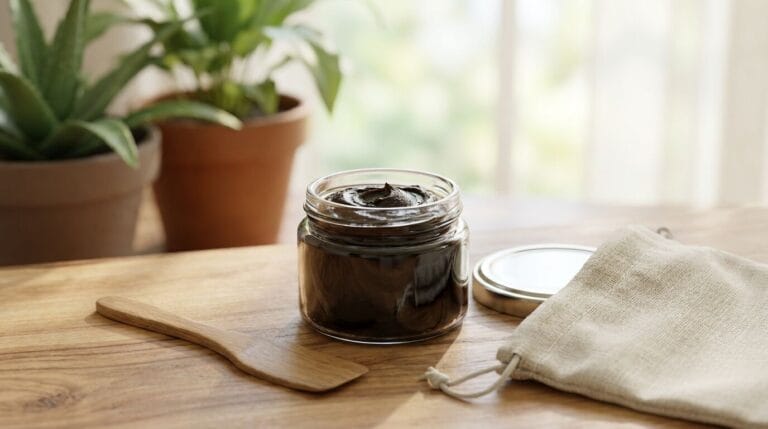
In Brief
- Shilajit is a natural concentrate whose preservation requires strict attention to temperature, humidity, and oxygen to maintain its potency. Optimal methods vary depending on the presentation: resin, powder, or capsules.
- Exposure to humidity, heat, or light alters the texture, appearance, and effectiveness of Shilajit, notably reducing its benefits in bodybuilding.
- Practical tips such as using clean utensils, a dry environment, or marking opening dates extend the product’s freshness.
- Knowing how to recognize deteriorated Shilajit protects you from risks while naturally maximizing your supplementation’s performance.
Poorly managed storage of Shilajit can quickly turn this ancient remedy into an ineffective or even dangerous product. Excessive heat, fluctuating humidity, and prolonged oxygen exposure lead to changes in texture, color, and odor. But most importantly, these factors compromise Shilajit’s active properties, its precious fulvic acids and minerals.
Many users report variations in their cure results when in fact it was simply… deterioration caused by poor storage. Differences depending on the chosen form—resin, powder, or capsules—make all the difference: each requires specific care, from the choice of container to respecting opening dates, to maintain freshness and effectiveness. Exploring these subtleties ensures you get the best from this treasure of Ayurveda, without mistakes or waste.
Shilajit as hard as stone: panic on board? (Quick answer)
Shilajit hardening always raises questions the first time. You open the jar, find a compact mass, and wonder if you bought a rock.
In reality, there are two possible and harmless explanations.
Cause #1: Cold
Raw Shilajit is a natural resin, not a laboratory-made powdered extract. Like any resin, it reacts to temperature. Heat makes it soft and slightly sticky. Cold contracts it until it almost completely solidifies.
You know honey crystallizing in winter, or coconut oil solidifying? The same mechanism. The product hasn’t changed, only its texture.
Cause #2: Evaporation of moisture
Shilajit naturally contains some water content, which contributes to its flexible and malleable consistency. If the jar was left open too long, poorly closed, or stored in a dry, airy place, this moisture gradually evaporates.
Result: the resin concentrates, retracts, and can become very hard, sometimes even more so than with just the effect of cold.
It is also, paradoxically, a sign of purity. Resin loaded with additives or synthetic binders would not react this way.
How to identify the cause?
It’s simple:
Was the jar in the cold or a cool room? → thermal cause
Was the jar left open or poorly closed? → moisture evaporation
Both at once? → combined effect, but the solution remains the same
How to soften your Shilajit
In both cases, the method is identical:
Pour a few drops of warm water directly into the jar
Close the lid and place the container in a warm place: on the refrigerator, in a temperate cupboard, or simply in a heated room
Wait 2 to 3 hours.
If the texture remains too firm, add a few more drops and repeat
Warm water replaces the lost moisture and heat releases the resin. Both levers act together.
Does it damage the product?
No — provided you don’t overdo the heat. Hardening and softening cycles do not damage the fulvic acids or active minerals of Shilajit, as long as you stay at a gentle temperature.
What you really need to avoid: hairdryers, boiling water, hot radiators. Intense heat degrades the active compounds. Gentle and gradual is the only rule.
How to prevent it from happening again
Two habits are enough:
Always close the jar well after each use; the main enemy is dry air
Store between 15 °C and 25 °C, away from direct light and major temperature variations
No need for a refrigerator; you will get exactly the opposite of what is wanted.
Understanding the importance of preserving Shilajit to maintain its active properties
The quality of Shilajit lies in its active components – minerals, fulvic acids, antioxidants – which are remarkably unstable when exposed to environmental hazards. Poor storage causes degradation of these precious elements, decreasing nutrient supply and the expected tonic effect. By experience, many users note decreased effectiveness when neglecting to protect their jar, especially during humid or hot periods.
Rigorous protection of Shilajit simultaneously ensures its purity and values every dose consumed over the months. This daily care prolongs the product’s shelf life as well as its natural strength.
Shilajit’s sensitivity to heat, humidity, and oxygen: risks of deterioration
Shilajit, a highly hygroscopic substance, triggers a whole chain of reactions under the influence of heat, humidity or after exposure to air. Excessively high temperature causes softening or liquefaction of the resin, while too much moisture favors mold development. Prolonged exposure to oxygen accelerates oxidation and causes Shilajit to lose its characteristic color and adaptogenic properties.
In some regions with significant temperature or humidity variations, the resin often becomes brittle or so soft that it drips from the jar. Paradoxically, the powder may form unwanted clumps, making intake difficult and unpleasant. Experienced users therefore opt for tailored solutions depending on the season or home climate.
Impact of good storage on effectiveness in bodybuilding and physical performance
For those who include Shilajit in their sports or bodybuilding routine, storage plays a key role. A well-preserved product offers better availability of minerals and fulvic acids, essential for energy support and recovery. If the resin deteriorates, it is difficult to benefit from its adaptogenic and hormonal regulation effects praised by recent studies: deterioration by heat or moisture simply reduces the supplement’s potency.
A frequently reported case: athletes notice stagnation or even decreased vitality after a few weeks because they used Shilajit stored in a bathroom or poorly closed. To sustainably benefit from Shilajit’s virtues in demanding disciplines, every storage detail is truly important.
Optimal methods for storing Shilajit according to its form: resin, powder, and capsules
Adapting storage to your Shilajit’s form maximizes the integrity of its active ingredients and the safety of its use. Resin, powder, capsules: each form requires distinct handling. Let’s examine best practices for each format in more detail.
Storing Shilajit resin: airtight jar, stable temperature, and protection from light
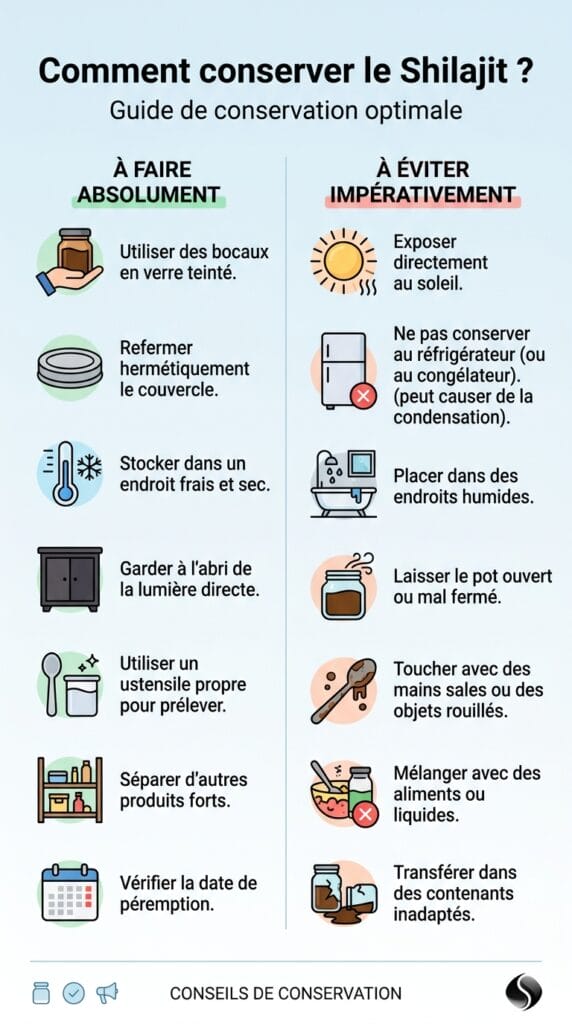
Shilajit resin requires a perfectly airtight jar (ideally glass, never plastic) to prevent any moisture or oxygen exchange. It is crucial to keep the jar away from light and in a place where the temperature remains stable – away from radiators and windows.
In case of high temperatures or for long-term storage, the refrigerator becomes a good ally. However, avoid condensation by allowing a gradual return to ambient temperature before each opening. This precaution limits the risk of droplets forming, which would encourage resin deterioration.
Storing powder and capsules: conditions of humidity, opacity, and original packaging
Shilajit powder must be stored in an airtight, dry, and opaque container. The goal is to protect it from moisture ingress, which mainly causes clumps or crusts. Tip users often use a small desiccant packet (like food-grade silica) placed inside the box to limit residual moisture.
Shilajit capsules must remain in their original packaging, rarely opened, away from any heat or light source. A dedicated drawer or kitchen cabinet not exposed to temperature variations will prolong their freshness. Whether you choose powder or capsules, always avoid bathrooms or any humid places.
Practical tips to limit contamination and preserve Shilajit quality
Limiting Shilajit contamination depends on rigor and consistency during handling. Experience shows that a simple oversight – improperly closed lid, wet utensil – can spoil several weeks of treatment. Optimize every gesture to ensure safe and efficient use.
Using clean, dry, and non-plastic utensils to handle Shilajit
Extraction of Shilajit resin must be done with a clean, completely dry metal spatula or spoon. Plastic gradually releases compounds that over time can interact with the resin or encourage moisture retention. An accessory reserved for this use, carefully washed after each removal, extends Shilajit’s longevity. For powder, this habit remains important to keep the supplement’s integrity and avoid any transfer of aromas or microbes.
Never: dip a wet spoon into the jar.
Do not: leave the lid open or expose the resin to sunlight.
Prefer: taking small amounts to limit exposure of the main reserve.
Store in a dry place, away from light and temperature fluctuations
Favor a storage space away from steam sources, kitchens, or bathrooms. A dry, dark, and temperate cupboard is ideal. Shilajit enthusiasts often invest in a dedicated small box to avoid unpleasant surprises, or place a desiccant packet in the jar in case of ambient humidity.
Limiting sudden temperature variations promotes resin stability. Consider organizing your space or labeling “Shilajit” on the spot to avoid confusion with other less demanding supplements.
Recognizing visible and olfactory signs of deteriorated Shilajit to avoid risks
Timely discovery of a spoiled product protects your health and saves you from wasting your next cure. Well-preserved Shilajit offers a homogeneous color, elastic texture (for resin), and characteristic earthy odor. At the slightest doubt, it’s better to play it safe.
Color change, abnormal texture, and unusual odor as key indicators
A marked variation in Shilajit’s hue such as whitish patches, exaggerated darkening, loss of shine signals potential degradation. The texture should remain soft and slightly sticky, never too dry or unusually liquid (except under extreme heat). A rancid or very acidic odor is an immediate warning sign. Such evolution often indicates moisture impregnation or a conservation fault.
Microbial contamination alert: presence of molds and safety recommendations
The appearance of filaments, spots, or foam on the surface indicates advanced microbial contamination. Contaminated Shilajit sometimes shows small bubbles, whitish deposit, or “stringy” texture, rarely harmless. In this case, discard the contents, thoroughly clean the jar, or change provider. Prevention always involves cleanliness and vigilance.
Symptom | Affected form | Recommended action |
|---|---|---|
Color change | Resin, powder | Monitor, do not consume if in doubt |
Abnormal texture | Resin | Check moisture, discard if moldy |
Suspect odor | All forms | Stop use, discard |
Visible molds | Resin, powder | Throw away product |
Recommended shelf life and tips for tracking Shilajit freshness
Shelf life varies according to Shilajit presentation: pure resin, well stored, comfortably lasts 6 to 24 months. Powder, more sensitive to moisture and repeated air contact, generally preserves for 6 to 12 months. Capsules, more stable thanks to their coating, keep their qualities for 12 to 36 months if kept in their original packaging.
Storage periods according to form: resin, powder, and capsules
Form | Optimal duration | Storage advice |
|---|---|---|
Resin | 6 to 24 months | Airtight jar, stable temperature, fridge possible |
Powder | 6 to 12 months | Dry box, opaque, moisture-limiting |
Capsules | 12 to 36 months | Original packaging, cool and dry place |
| Liquid | 6 to 8 months | Cool, dry place at room temperature (15 to 25 °C) |
It is important to favor small packages adapted to your consumption pace to avoid prolonged storage and keep Shilajit’s freshness all year long.
Marking opening dates and portion management to limit repeated openings
Adopt the habit of indicating the opening date on each Shilajit container, especially for resin and powder. For regular users, pre-measure small amounts into a secondary jar to limit exposure of the main stock to air and humidity. This simple act significantly increases your supplement’s longevity.
Final tip: keep your purchase receipts and track any unusual changes by comparing with new product or manufacturer documentation.
How to best preserve Shilajit resin’s effectiveness?
Always use an airtight glass jar, avoid light, and keep the resin at stable room temperature. In case of strong heat, temporarily store in the refrigerator after waiting a few minutes before opening to avoid condensation.
Does Shilajit powder really fear humidity?
Yes, powder easily absorbs surrounding humidity, causing clumps and quality loss. Store it in a dry, opaque box away from humid rooms.
Can I mix my Shilajit supplements in the same jar to save space?
It is not recommended to mix different forms or sources of Shilajit in one jar to avoid cross-contamination and preserve traceability. Always favor storage in the original distinct packaging.
What are the risks of repeated contact with air?
Regular exposure to air accelerates oxidation and degradation of Shilajit’s active principles, reducing its effectiveness and promoting abnormal odors or textures. Limiting unnecessary openings is advised.
Should I throw away Shilajit that has developed a strange odor or changed appearance?
Yes, if Shilajit has a suspect odor, strange color, or unusual texture (liquefaction, crystallization, mold), it is safer to discard it to avoid health risks.

As a wellness consultant with over 10 years of experience, I help individuals and businesses incorporate natural health practices to improve their quality of life on a daily basis.