
In Brief
Fulvic acid is a natural fraction of soil organic matter, derived from the slow decomposition of plants and microorganisms.
Its small molecular size and high reactivity explain its role in the mobilization of nutrients and the biological balance of soils.
In agriculture, it can promote mineral absorption, support root vigor, and improve plants’ tolerance to certain stresses.
Its relevance for human health exists mainly in the field of natural medicine and supplements, but clinical data remain to be interpreted with caution.
The most relevant uses rely on reasoned applications, appropriate doses, and careful evaluation of product quality.
Fulvic acid intrigues farmers, gardeners, and natural nutrition enthusiasts alike. This substance, less known than classic fertilizers or the major soil minerals, nevertheless plays a discreet yet central role in nutrient circulation. In living soil, it acts as an effective intermediary between organic matter, minerals, and roots. This is often what makes the difference between a merely nourished soil and a truly functional soil.
Its name also appears in the wellness universe, particularly through certain extracts of humic substances and products associated with shilajit. However, the subject deserves a serious approach. The potential effects are interesting but should never be presented as medical certainties. To fully understand the value of fulvic acid, one must start from the ground: its formation in soils, its chemical properties, its influence on plants, and then its practical uses. This journey, from the most fundamental to the most concrete, allows evaluating its true usefulness.
What is fulvic acid?
Precise definition of fulvic acid and its natural sources
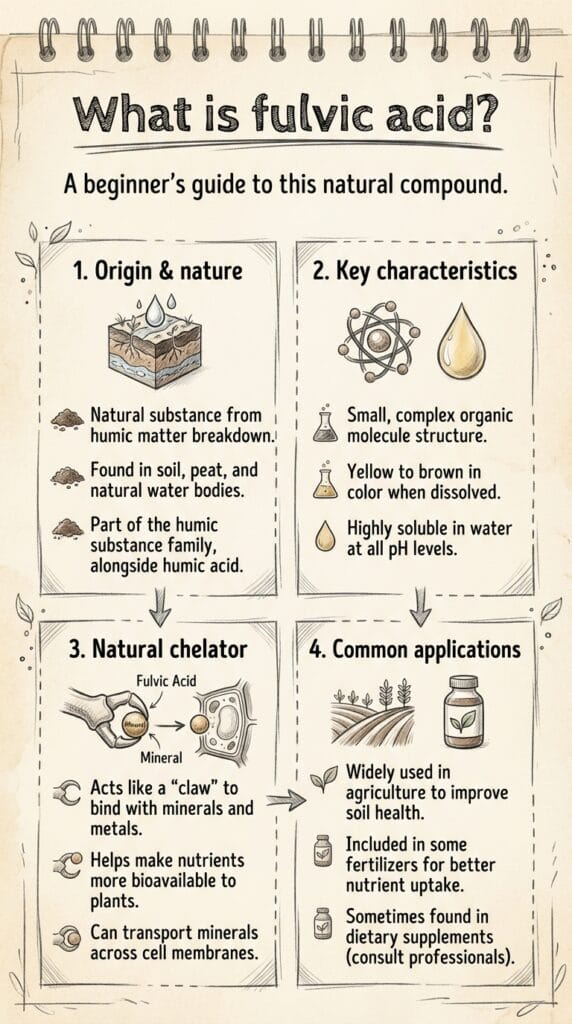
Fulvic acid is a component of humic substances, alongside humic acid and humin. It forms during humification, which is the gradual transformation of plant, animal, and microbial residues into stable organic matter. Its major characteristic lies in its solubility in water at all pH levels, making it particularly mobile in soil.
It naturally occurs in soils rich in organic matter, mature compost, certain peats, ancient sediments, and some organic mineral substances such as shilajit. In agricultural practice, commercial extracts often come from Leonardite, an oxidized organic material rich in humic compounds. The source matters greatly as it influences product purity, concentration, and possible presence of undesirable impurities.
To visualize its role, imagine a vegetable garden after several years of mulching, composting, and crop rotations. The soil becomes more supple, darker, retains water better, and nourishes crops more consistently. Fulvic acid does not do everything alone but strongly contributes to this dynamic. It is one of the signatures of a biologically active soil.
Therapeutic effects and benefits of fulvic acid on human health
Modes of action and therapeutic applications of fulvic acid in natural medicine
In the wellness domain, fulvic acid is studied for its antioxidant properties, possible interaction with certain minerals, and potential role in the bioavailability of nutritional compounds. Part of this interest stems from research on shilajit, which contains variable fulvic fractions depending on its origin and purification method.
The proposed mechanisms remain cautious. Experimental work suggests activity on ion transport, oxidative stress, and some inflammatory processes. This does not mean a fulvic acid supplement replaces medical treatment. The proper perspective is to talk about biological leads, not automatic healing.
In practice, interested individuals often use it to support vitality, digestive balance, or mineral intake. The most reasonable advice remains simple: choose a traceable product, avoid opaque formulations, and seek professional guidance in case of treatment, pregnancy, or chronic pathology. In the supplement world, caution is a sign of seriousness.
Clinical studies and scientific evidence of fulvic acid benefits on human health
Scientific literature exists but is heterogeneous. Some studies focus on purified shilajit rather than isolated fulvic acid, so one must not mix everything. For example, a paper by Carrasco-Gallardo, Guzmán, and Maccioni in the International Journal of Alzheimer’s Disease in 2012 explored the neurobiological potential of shilajit and its fulvic components. The authors stated that fulvic acid might be considered “a promising nutraceutical candidate,” which is a research perspective, not definitive clinical proof.
Another often-cited reference is the review by Ghosal and colleagues on shilajit composition and traditional uses, published in the Journal of Ethnopharmacology. These works helped popularize the topic but are insufficient to establish robust medical benefits for all claimed uses. To date, large-scale human trials remain limited.
To keep a credible framework, here is a useful benchmark.
Area studied | Level of evidence | Cautious interpretation |
|---|---|---|
Antioxidants | Preclinical to moderate | Interesting but still insufficient for strong claims |
Mineral bioavailability | Mechanistic and observational | Plausible according to chemistry, variable depending on products |
Energy and wellbeing | Limited human data | Possible effects, but dependent on context and supplement quality |
Sources available: PubMed, International Journal of Alzheimer’s Disease, Journal of Ethnopharmacology, EFSA for the European regulatory framework. Research is useful but always requires nuanced reading.
Additional perspectives: potential use in health and wellbeing
Outside the strict medical field, fulvic acid attracts attention for its image as a natural support. It is found in formulas oriented toward micronutrition, recovery, and general balance. This interest is explained by its ability to interact with mineral compounds and its presence in complex natural matrices.
The key point is to distinguish traditional use, scientific hypothesis, and clinical validation. This distinction protects against announcements. A product can be coherent in a wellness routine without necessarily having a therapeutic status. This is precisely the boundary to respect in order to remain reliable.
A scene often reappears in specialized store exchanges: an amateur athlete looks for “something natural” to recover better. The good advice is not to rush into a trendy active ingredient but first check sleep, protein intake, iron or magnesium status, hydration, and digestive quality. If chosen, fulvic acid comes after the basics, never instead of the basics.
Biological and chemical formation in soils
The formation of fulvic acid relies on a long chain of degradation and recomposition. Bacteria, fungi, and other soil organisms break down dead leaves, roots, exudates, and organic residues. Over time, these materials lose their initial structure and give rise to more complex molecules, including fulvic compounds.
This process depends on climate, pH, oxygenation, moisture, and type of vegetation. Forest soil, well-managed compost, and old meadow do not produce exactly the same humic profiles. Generally, the richer the biological activity and the more diverse the organic matter, the more interesting the humic fractions. This is why overexploited or severely depleted soils often show lower fulvic activity.
Chemically, fulvic acid possesses many functional groups, notably carboxyl and phenolic groups. This structure allows it to bind minerals and participate in complex exchanges in the rhizosphere. Behind this somewhat technical term hides a simple idea: it serves as a vector between soil and plant.
Distinctive physical and chemical properties of fulvic acid
Fulvic acid is distinguished by its low molecular weight compared to other humic fractions. This grants it better mobility in water and a particular ability to cross some biological media. It is also known for its color ranging from yellow-brown to amber-brown, lighter than that of humic acids.
Its most studied properties are its chelating capacity, its variable electrical charge depending on the medium, its large reactive surface, and its ability to complex elements like iron, zinc, copper, or manganese. Concretely, it can help these nutrients remain more available in the root environment. This is especially useful in calcareous soils where some trace elements quickly become blocked.
A little-known but useful detail: very dark extracts are not always synonymous with better fulvic quality. Some products very rich in humic acids appear visually more impressive, while the fulvic fraction is mainly measured by analysis. The good reflex is therefore to check the composition, not just the appearance.
Fundamental role of fulvic acid in soil structure
Fulvic acid’s role is not limited to mineral transport. It also contributes to the physical organization of the soil, interacting with clays, organic matter, and microorganisms. It helps maintain stable aggregates, those small structures that give soil an aerated and lively texture.
Well-structured soil infiltrates water better, limits runoff, resists compaction more, and offers roots easier exploration. In a garden, this translates into soil that sticks less in winter and crusts less in summer. For a vegetable grower, this can reduce growth differences between two identical beds on paper but different in their biological life.
When fulvic acid is associated with a good level of organic matter, it becomes an ally for sustainable fertility. It does not act like a fast fertilizer but as a balance facilitator often felt over several cultivation cycles.
Role of fulvic acid in soil fertility and plant health
Chemical properties favoring nutrient retention and mobilization
In soil, fulvic acid acts as a mediator. It can retain certain elements, then render them more easily available to the plant according to local conditions. This behavior is valuable in soils poor in organic matter, leached, or imbalanced due to poorly timed mineral inputs.
Its interest is especially visible with micronutrients. Iron, zinc, manganese, or copper can become poorly accessible despite their real presence in soil. Fulvic acid helps keep them in a more mobile form. Result: more regular nutrition and fewer silent blockages. This is often what growers facing chlorosis or stagnating crops without obvious cause seek.
Chelating actions and facilitation of mineral absorption
Chelation refers to a molecule’s ability to bind a metal ion. In the case of fulvic acid, this property can improve the transport of certain minerals in the soil solution. This mechanism does not necessarily add nutrients by itself but sometimes optimizes what is already present.
A concrete example: in a calcareous plot, tomatoes may have pale foliage despite adequate trace element supply. The reasoned addition of a fulvic extract, combined with improved organic matter, can help restore smoother assimilation. The keyword here remains reasoned. Without a basic diagnosis, one risks treating a symptom without correcting the cause.
Interaction with organic matter and soil microflora
Fulvic acid works better in a living ecosystem than in depleted soil. It interacts with organic residues, colloids, and the soil microflora. This relationship is essential because bacteria and fungi transform matter, release enzymes, and participate in nutrient exchanges around roots.
When a gardener combines mature compost, soil cover, and light fulvic input, the observed effects are often more coherent than with isolated application. The soil retains more moisture, roots colonize the profile better, and reestablishment after planting is steadier. The lesson is clear: fulvic acid gives its best when part of a global biological fertility strategy.
Interactive comparator
Fulvic acid, humic acid, or mineral fertilizer?
Quickly compare their origin, solubility, main role, speed of action, impact on soil, recommended use, and precautions to know.
| Criterion |
Fulvic acid
|
Humic acid
|
Mineral fertilizer
|
|---|
Quick reading
Fulvic acid is mainly appreciated for its strong solubility and its capacity to facilitate assimilation. Humic acid acts more on soil structure and quality. Mineral fertilizer provides nutrients more directly and often faster.
Practical advice
To sustainably improve poor soil, humic acid is often relevant. To optimize absorption and accompany fertilization, fulvic acid is generally more targeted.
Watchpoint
A mineral fertilizer can be effective quickly, but excessive use can unbalance the soil. Respecting doses remains essential in all cases.
Biological impacts on plant growth and resistance
Beyond chemistry, biological effects on general crop vigor are observed. Several agronomic trials report improved root development, more uniform growth, and sometimes better tolerance to stresses such as moderate drought or salinity. Responses vary depending on species, dose, application stage, and soil condition.
Among vegetable growers, frequent feedback concerns young plant quality. Early applications in modest doses seem to support quicker establishment after transplanting. This does not replace good irrigation or consistent fertilization but can reduce stagnation phases. A well-established plant consumes better, photosynthesizes more efficiently, and resists better. The whole chain follows.
Positive effects of fulvic acid on human and animal health
The link between soil, plant, animal, and human remains one of the most exciting aspects. Better-structured soil with more regular mineral nutrition helps produce plants of better agronomic quality. This does not guarantee a direct automatic benefit on human or animal health but supports the idea of a biological quality chain.
In animal feed, some research explores the use of humic substances as support for the digestive environment or oxidative stress management. Again, results depend on species, matrices, and protocols. The principle to remember is simple: improving the base, from soil to ration, often offers more credible effects than chasing a miracle product at the chain’s end.
Benefits of fulvic acid for plants: enhanced growth and health
Improvement of essential nutrient absorption
The most regularly highlighted benefit is improved nutrient assimilation. By facilitating the availability of several minerals, fulvic acid helps the plant better use what the soil already contains or what has been added by fertilization. This nuance is crucial: it acts more as an optimizer than as a massive nutrient source.
In demanding crops such as peppers, strawberries, or citrus, this better use may translate into more balanced growth. Leaves retain a deeper color, stems are less fragile, and differences between plants decrease. This regularity, more than yield explosion, often represents the real value of a fulvic input.
Effect on roots and mineral assimilation
The root is the primary area where fulvic acid expresses itself. A dense, active, well-branched root system multiplies exchange surface with soil. Several observations in cultivation show improved establishment, notably after transplanting or light water stress. This particularly interests seedling producers and gardeners seeking to secure early season starts.
A little-known tip is to favor low repeated doses rather than very concentrated single applications. This approach, used by several professionals, limits peaks and better fits the plant’s actual rhythm. With fulvic compounds, regularity often yields better results than overdoing it.
Stimulation of photosynthesis and plant development
When nutrition flows more smoothly and roots function better, the plant can more effectively sustain photosynthesis. Indirectly, fulvic acid can thus participate in better biomass production. This is observed in foliage, the vigor of young shoots, and sometimes in visual crop quality.
However, this factor should not be isolated. Without sufficient light, well-managed water, and proper soil structure, the effect will remain limited. Fulvic acid amplifies a favorable dynamic; it cannot sustainably compensate for major management errors. This systemic logic precisely avoids disappointments.
Desired effect | What fulvic acid can provide | Condition to benefit |
|---|---|---|
Post-planting establishment | Support for root activity | Regular watering and non-compacted soil |
Mineral nutrition | Better availability of certain elements | Presence of nutrients in soil |
General vigor | More uniform growth | Consistent cultural program |
Strengthening plant resistance to diseases and stress
A well-nourished and rooted plant resists better. This is the most credible benefit to retain. Fulvic acid is not a pesticide nor an absolute shield but can support stress tolerance by improving the crop’s general condition. Against heat episodes, salinity, or soil fatigue, this supportive effect becomes interesting.
Field observations also show better performance on crops subjected to irrigation fluctuations. Again, it is physiological support, not a guarantee. When a gardener describes zucchinis that “start strong then falter,” the cause often lies in a mixture of water imbalance, compacted soil, and irregular nutrition. Fulvic acid can help but only if this trio is corrected simultaneously.
Practical applications of fulvic acid in agriculture and gardening
Common forms and modes of fulvic acid use
Fulvic acid is found in liquid form, soluble powder, granules combined with other organic matter, or integrated into complete humic formulations. Liquid products are often favored for fertigation or foliar spraying applications, while powders interest users wanting better control over dilution and cost.
The key point is to read the label carefully. The “humic” mention does not necessarily mean a high fulvic fraction. One must check percentages, extraction source, heavy metal analyses, and usage instructions. For serious use, a less flashy marketing product with clearer composition is preferable.
Use as supplement or organic amendment
In agriculture, fulvic acid is often used as a fertilization supplement or as support for soil regeneration strategies. It complements well compost inputs, organic extracts, some mineral solutions, and biostimulation programs. In gardening, it may be used at transplanting, vegetative start, or during predictable stress periods.
Here are the most common uses:
Soil watering to support the root zone
Fertigation in irrigated crops
Foliar spraying at low doses depending on products
Association with compost or organic amendments in a sustainability fertility logic
In a small garden, a simple use consists of applying it at spring transplanting, then once or twice during the establishment phase. This sober method often yields better feedback than too frequent use without a clear objective.
Application techniques to maximize efficacy in crops
To achieve coherent results, a few principles change everything. First, working on slightly damp soil improves diffusion. Then, respecting manufacturer doses avoids unnecessary overconcentration. Finally, synchronizing supply with periods of high plant demand, such as rooting, establishment, or active growth, increases chances of visible effect.
The most useful good practices are often the simplest:
Split applications rather than concentrate the dose at once
Avoid treatments during heat stress or full sun for foliar applications
Combine use with improving organic matter content
Observe real crop responses over 2 to 4 weeks
For highly monitored operations or vegetable gardens, keeping a small crop log remains a highly effective method. Date, dose, weather, foliage state, root vigor: in a few lines, you finally distinguish what really works from impressions. With fulvic acid, this discipline often makes all the difference between an “interesting” product and a truly useful tool.
Is fulvic acid a fertilizer?
No. Fulvic acid is not a fertilizer in the traditional sense. It mainly provides a facilitating effect on the availability and circulation of certain nutrients already present in the soil or added by fertilization.
What is the difference between fulvic acid and humic acid?
Both belong to humic substances, but fulvic acid is generally lighter, more mobile, and soluble in water at all pH levels. Humic acid is often heavier, less mobile, and more associated with soil structuring.
Can fulvic acid be used in amateur gardening?
Yes, provided a product clear about its composition is chosen and dosages respected. Use is mainly relevant for transplanting, rooting, and supporting balanced organic fertilization.
Is fulvic acid proven for human health?
Scientific data are encouraging but still limited depending on uses. Some research focuses on complex extracts like purified shilajit. Therefore, excessive claims should be avoided and medical advice sought if in doubt or particular situations.
Sources and scientific references
1. Study on safety and microbiota
- Authors: Zhang, Y., et al.
- Full title: Integrated safety and microbiota profiling of fulvic acid formulations across in vitro and in vivo models.
- Publication/Journal: Evidence-Based Complementary and Alternative Medicine (via PubMed Central).
- Date: 2026.
- DOI link: 10.1155/2026/8492031
2. Summary on benefits and precautions
- Authors: Healthline Editorial Team.
- Full title: Fulvic Acid: Benefits, Safety, Side Effects, and Dosage.
- Publication/Journal: Healthline.
- Date: 2025.
- Link: https://www.healthline.com/nutrition/fulvic-acid
3. Fact sheet and interactions
- Authors: WebMD Editorial Contributors.
- Full title: Fulvic Acid: Overview, Uses, Side Effects, Precautions, Interactions, Dosing and Reviews.
- Publication/Journal: WebMD.
- Date: 2026 (Regularly updated).
- Link: https://www.webmd.com/vitamins/ai/ingredientmono-1320/fulvic-acid

As a wellness consultant with over 10 years of experience, I help individuals and businesses incorporate natural health practices to improve their quality of life on a daily basis.